
Rembrandt’s Mother
Medium
etching
Dimensions
63; 65
Rights
Public Domain
About this artwork
monogram en datum, rechtsboven: ‘RHL 1628’
Art Historical Context
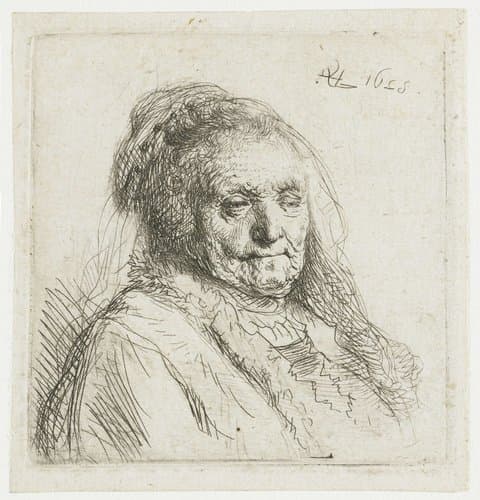
In 1628, at just 22 years old, Rembrandt van Rijn created *Rembrandt’s Mother*, a tender etching measuring a mere 65mm by 63mm—small enough to fit in the palm of your hand. Signed with his monogram "RHL" (for Rembrandt Harmensz van Leiden) and the date in the upper right, this intimate portrait captures his mother, Neeltgen van Zuytbrouck, gazing thoughtfully. Produced during his early years in Leiden, it reflects the Dutch Golden Age's emphasis on personal and domestic subjects amid a booming market for affordable prints. As one of Rembrandt's earliest etchings, it showcases his budding genius for printmaking, a medium he would master and innovate throughout his career. Etching, involving acid biting into a metal plate to create fine lines, allowed Rembrandt to achieve remarkable depth and texture even on this tiny scale. The subtle play of light on her face hints at the dramatic chiaroscuro that would define his mature style, blending realism with emotional insight. This work holds cultural significance as a window into Rembrandt's family life and artistic origins, before his fame in Amsterdam. It reminds us how even masters began with humble, heartfelt studies, making prints like this accessible to a wide audience and spreading his reputation far beyond paintings. A gem of technical skill and filial affection!
About the Artist
Rembrandt van Rijn · 1606–1669
Rembrandt Harmenszoon van Rijn (1606–1669) stands as one of the greatest visual artists in the history of Western art and the most important Dutch painter of the 17th century. Born in Leiden to a prosperous miller's family, Rembrandt transformed painting through his revolutionary use of light and shadow, his psychological depth in portraiture, and his elevation of etching to a fine art. His approx...