
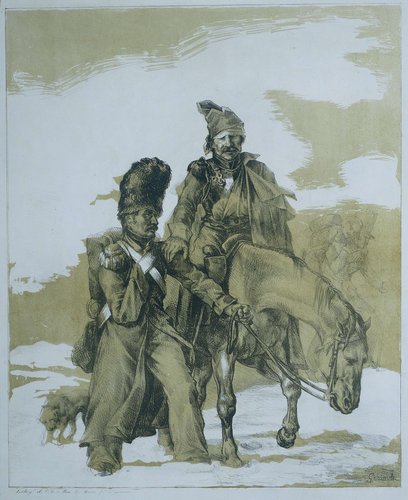
Retour de Russie
Medium
lithography
Dimensions
445; 362
Rights
Public Domain
About this artwork
Purchased with the support of the F.G. Waller-Fonds
Art Historical Context
**Retour de Russie (Return from Russia), Théodore Géricault,1818** Théodore Géricault, leading figure of French Romanticism, created *Retour de Russie* as a poignant lithography measuring 445 × 362 mm. Known for his dramatic depictions of human anguish, such as in *The Raft of the Medusa* (1818–19), Géricault turned to lithography—a revolutionary printmaking technique he helped pioneer in France. This medium allowed for rich, painterly effects through greasy crayon on stone, enabling mass reproduction of his emotionally charged images. The work captures the harrowing aftermath of Napoleon's ill-fated 1812 Russian campaign, part of the broader Napoleonic Wars. It portrays a wounded soldier limping home, embodying the physical and psychological toll on veterans amid France's post-war turmoil. Géricault's unflinching realism highlighted the human cost of glory, challenging neoclassical ideals and aligning with Romanticism's focus on passion, suffering, and individualism. Acquired with support from the F.G. Waller-Fonds, this print exemplifies Géricault's brief but influential foray into lithography before his early death at 32. It invites visitors to reflect on war's enduring scars, blending technical innovation with profound empathy.
About the Artist
Théodore Géricault · 1791–1824
Théodore Géricault (1791-1824) stands as one of the most influential pioneers of French Romanticism, despite a career tragically cut short at age thirty-two. Born in Rouen on September 26, 1791, into a wealthy family, Géricault's brief but intense artistic life transformed the trajectory of nineteenth-century European painting. Géricault began his formal training in 1808 under Carle Vernet, maste...