
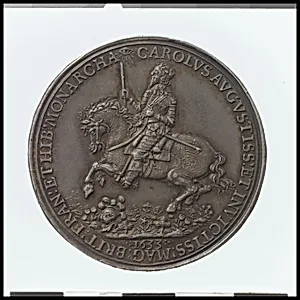
Return of Charles I to London after the Coronation at Edinburgh
1633
Medium
Silver
Dimensions
Diameter: 42 mm
Classification
Medals and Plaquettes
Culture
British
Department
European Sculpture and Decorative Arts
Museum
Metropolitan Museum of Art, New York, NY
Credit
Gift of Assunta Sommella Peluso, Ada Peluso, and Romano I. Peluso, in memory of Ignazio Peluso, 2001
Accession Number
2001.432.3
Rights
Public Domain
Tags
Art Historical Context
This silver medal by Nicholas Briot captures a pivotal moment in British royal history: the return of King Charles I to London following his coronation as King of Scotland in Edinburgh in 1633. Created in the same year, the work commemorates the monarch’s journey southward, blending political symbolism with the artistry of early Stuart court culture. Briot, a skilled medallist serving as chief engraver at the Royal Mint, used the circular format to convey both grandeur and intimacy, allowing viewers to hold a tangible record of the event. Measuring just 42 millimeters in diameter, the medal exemplifies the Renaissance tradition of commemorative objects that merged sculpture and currency. Rendered in silver, it likely features the king alongside motifs such as horses, boats, and swords—elements that evoke the royal procession and the challenges of travel by land and sea. Such details highlight the medal’s role not only as art but as a portable emblem of loyalty and power during a period of growing tension between crown and parliament. Today housed in the Metropolitan Museum of Art’s collection of European Sculpture and Decorative Arts, this piece offers modern visitors a glimpse into 17th-century British identity. Its donation in memory of Ignazio Peluso underscores the enduring appeal of these small yet powerful objects, which once circulated among courtiers and collectors alike.