
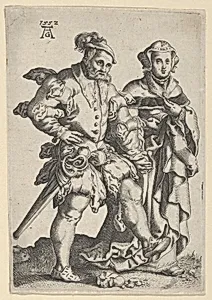
Reverse Copy of Dancing Couple, from "The Small Wedding Dancers"
Medium
Engraving
Dimensions
Sheet: 4 5/8 × 3 1/4 in. (11.7 × 8.2 cm)
Classification
Prints
Department
Drawings and Prints
Museum
Metropolitan Museum of Art, New York, NY
Credit
Harris Brisbane Dick Fund, 1917
Accession Number
17.3.486
Rights
Public Domain
Tags
Art Historical Context
This charming engraving, titled *Reverse Copy of Dancing Couple, fromThe Small Wedding Dancers*, dates to 1552 and is attributed to Heinrich Aldegver or an anonymous German of the 16th century. Measuring just 4 5/8 × 3 1/4 inches, its petite scale invites close inspection, capturing a joyful pair mid-dance with lively energy. Aldegrever, a prominent member of the "Little MastersGerman engravers famed for intricate small-format works—excelled in depicting everyday scenes, blending Renaissance precision with Northern European flair. Created via engraving, a technique where metal plates are incised with fine lines for inked impressions, this print reflects the era's booming print culture. It reproduces motifs from a series evoking wedding festivities, where dance symbolized celebration and courtship. The "reverse copy" likely mirrors an original, a common practice for adapting designs across workshops, highlighting prints' role in disseminating art to wider audiences beyond elite patrons. In 16th-century Germany, such images celebrated social rituals amid Reformation tensions, offering a glimpse into communal merriment. Now in the Metropolitan Museum of Art's Drawings and Prints collection (Harris Brisbane Dick Fund, 1917), it reminds us how art froze fleeting moments of human connection, making high art accessible and intimate.
About the Artist
Heinrich Aldegrever|Anonymous, German, 16th century · 1502–1561
Heinrich Aldegrever, born in 1502 in Paderborn, Westphalia, to parents Herman and Katherine Trippenmeker—a family of clog-makers known by the dialect name Trippenmecker—emerged as a multifaceted artist in the German Renaissance. His early training remains undocumented, though he likely apprenticed in a Soest goldsmith's workshop after relocating there around 1525, where he joined the painters' gui...