
Revoluties
Medium
lithography
Dimensions
279; 366
Rights
Public Domain
About this artwork
collector's mark: Lugt 2228a
Art Historical Context
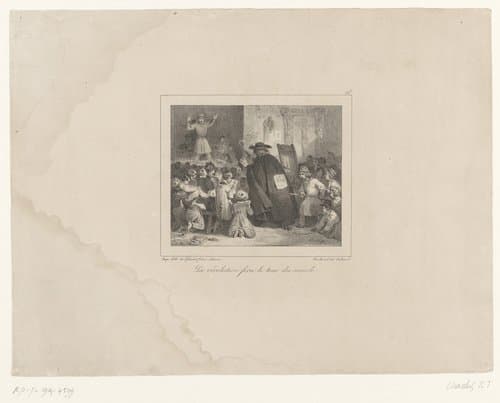
Nicolas Toussaint Charlet (1792–1845), a prolific French lithographer and painter, captures the turbulent spirit of early 19th-century France in *Revoluties* (1831). Known for his witty military scenes and satirical depictions of soldiers—often drawing from his own service in Napoleon's Imperial Guard—Charlet produced this work amid the aftershocks of the July Revolution of 1830. That uprising had toppled the Bourbon monarchy, ushering in the July Monarchy under Louis-Philippe, a period rife with political unrest and revolutionary fervor. The title, evoking "revolutions," likely nods to these upheavals, blending Charlet's nostalgic Bonapartism with sharp social commentary. Rendered in lithography—a revolutionary printing technique invented in 1798 that allowed for affordable, mass-produced images on stone—*Revoluties* measures 279 × 366 mm, ideal for broad dissemination via newspapers and pamphlets. This medium democratized art, amplifying political satire among the working classes and bourgeoisie. Charlet's loose, expressive style, rooted in Romanticism, infuses his prints with humor and humanity, making soldiers relatable everymen rather than mere heroes. Bearing the collector's mark Lugt 2228a, this piece hails from a distinguished provenance, underscoring its enduring appeal. For visitors, it offers a vivid window into how lithography fueled public discourse during France's revolutionary era, turning art into a tool for reflection and rebellion.
About the Artist
Nicolas Toussaint Charlet · 1792–1845
Comment on works: genre