
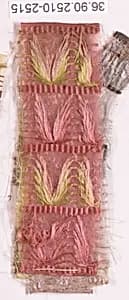
Ribbon
Unknown Artist
19th century
Classification
Textiles-Trimmings
Culture
French
Department
European Sculpture and Decorative Arts
Museum
Metropolitan Museum of Art, New York, NY
Credit
Gift of The United Piece Dye Works, 1936
Accession Number
36.90.2513
Rights
Public Domain
Art Historical Context
This exquisite 19th-century French, housed in the Metropolitan Museum of Art's Department of European Sculpture and Decor Arts, exemplifies the artistry of textiles as everyday luxury. Classified as a trimming, it would have adorned garments, upholstery, or accessories during an era when France led the world in fashionable textiles. Produced in a time of industrial innovation, such ribbons highlight the blend of handcraft and emerging machinery that made Lyon, France's silk capital, synonymous with opulent weaves. Though the artist remains unknown, the ribbon's cultural significance lies in its role within decorative arts, where trimmings elevated ordinary objects into statements of style and status. French textiles from this period often featured intricate patterns achieved through Jacquard looms, revolutionizing production while preserving aesthetic finesse. Donated in 1936 by The United Piece Dye Works—a nod to early 20th-century textile expertise—this piece invites us to appreciate the subtle splendor of functional art. Today, it reminds visitors of fashion's democratic touch: ribbons democratized elegance, appearing in homes from Parisian salons to provincial ateliers, weaving history into the fabric of daily life.