
Rijstplanters
1763 - 1767
Medium
color woodcut
Dimensions
310; 138
Rights
Public Domain
About this artwork
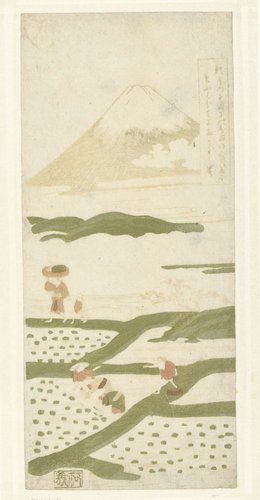
Drie mensen werkend in een rijstveld, een vierde op de dijk staand bij een mand; vrouw met kind aan linker hand, lopend met mand op hoofd; de berg Fuji op de achtergrond.
Art Historical Context
Suzuki Harunobu's *Rijstplanters* (Rice Planters), created between 1763 and 1767, captures a serene moment of rural Japanese life through the delicate art of color woodcut. This narrow vertical print (310mm high by 138mm wide) three figures laboring in a lush rice paddy, with a fourth standing on a nearby dyke beside a basket. To the left, a woman purposefully with a basket balanced on her head, a child clinging to her hand while the iconic Mount Fuji looms majestically in the background. Harunobu, a master of ukiyo-e—"pictures of the floating world"—brings everyday beauty to life with his innovative full-color technique, known as nishiki-e or "brocade pictures." Produced during Japan's Edo period, the artwork reflects the vital rhythm of rice cultivation, a cornerstone of agrarian society and the agricultural calendar. Rice planting was a communal, seasonal ritual symbolizing renewal and sustenance, often celebrated in art for its harmony with nature. Harunobu's inclusion of Fuji evokes national pride and spiritual reverence, as the mountain was a sacred landmark frequently featured in prints. Artistically, this woodcut showcases Harunobu's pioneering use of multiple woodblocks for vibrant hues—up to 10 colors—revolutionizing printmaking around 1765. His fine lines and subtle gradients create depth and intimacy, making elite art accessible to commoners. A charming glimpse into 18th-century Japan, *Rijstplanters* invites us to appreciate the quiet dignity of labor amid timeless landscapes.
About the Artist
Suzuki Harunobu · 1725–1770
Suzuki Harunobu (c. 1725-1770) was a Japanese ukiyo-e artist who revolutionized woodblock printing by developing nishiki-e—full-color prints using multiple woodblocks—in 1765. Before Harunobu, Japanese prints were limited to two or three colors; his innovation unleashed the entire artist's palette, transforming ukiyo-e into the vibrant art form that would later captivate Western artists from Manet...