
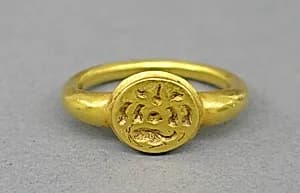
Ring with Oval Bezel with Fish Motif and "Sri" Inscription
Unknown Artist
Second half of the 9th–first quarter of the 10th century
Medium
Gold
Dimensions
H. 1/8 in. (0.3 cm); Diam. 1 in. (2.5 cm)
Classification
Jewelry
Culture & Period
Indonesia (Java) · late Central Javanese period
Department
Asian Art
Museum
Metropolitan Museum of Art, New York, NY
Credit
The Samuel Eilenberg-Jonathan P. Rosen Collection of Indonesian Gold, Bequest of Samuel Eilenberg and Gift of Jonathan P. Rosen, 1998
Accession Number
1998.544.403
Rights
Public Domain
Art Historical Context
This exquisite gold ring from late Central Javanese period (second half of the9th–first quarter the 10th century showcases the refined artistry of Java's Hindu-Buddhist kingdoms such as the Sailendra. Measuring just 1 inch in diameter with an oval bezel rising 1/8 inch, the ring features a delicate fish motif—likely symbolizing abundance, fertility, or aquatic life revered in ancient Southeast Asian cosmology—and an inscription reading "Sri," an auspicious Sanskrit term invoking prosperity, beauty, or the goddess of wealth and royal fortune. Such jewelry adorned the elite, reflecting the era's wealth from trade and temple patronage. Crafted from pure gold, the ring demonstrates sophisticated metalworking techniques like hammering, chasing, and engraving, common in Javanese goldsmithing. These pieces were not mere ornaments but talismans, blending aesthetic elegance with spiritual potency amid the construction of grand monuments like Borobudur and Prambanan. Part of The Samuel Eilenberg-Jonathan P. Rosen Collection at The Metropolitan Museum of Art, it offers a intimate glimpse into daily life among Java's nobility during a golden age of cultural flourishing.