
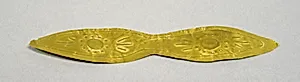
Ritual Eye Mask
Unknown Artist
3rd century–second half of the 8th century
Medium
Gold
Dimensions
W. 4 5/8 in. (11.7 cm)
Classification
Metalwork
Culture & Period
Indonesia (Java) · Protoclassic period
Department
Asian Art
Museum
Metropolitan Museum of Art, New York, NY
Credit
The Samuel Eilenberg-Jonathan P. Rosen Collection of Indonesian Gold, Bequest of Samuel Eilenberg and Gift of Jonathan P. Rosen, 1998
Accession Number
1998.544.52
Rights
Public Domain
Art Historical Context
This exquisite **Ritual Eye Mask**, from gleaming gold, hails from ancient Java, Indonesia, during the Protoclassic (3rd century to the second half of the 8th). Measuring just 4⅝ inches wide, this delicate metalwork piece was likely worn or used in ceremonial contexts, evoking the mystical world of early Southeast Asian rituals. Its small scale and precious material suggest it belonged to elite spiritual practices, possibly linked to shamanic traditions or ancestor veneration before the rise of grand Hindu-Buddhist temples. Gold's rarity and luster made it a supreme medium for ritual objects in ancient Java, symbolizing divine power, purity, and the sun's eternal light. Artisans employed sophisticated repoussé or chasing techniques—common in protoclassic metalwork—to shape its form, highlighting the era's advanced craftsmanship amid trade networks spanning India and China. Now part of the Metropolitan Museum of Art's Asian Art collection, thanks to the Samuel Eilenberg-Jonathan P. Rosen bequest, this mask offers a rare glimpse into Java's protoclassic world, bridging prehistory and classical splendor. Imagine it adorning a ritual dancer, eyes transformed into portals to the divine!