
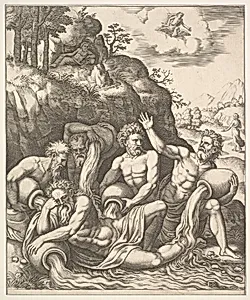
River gods consoling Peneus for the Loss of his Daughter, Daphne from 'The Story of Apollo and Daphne'
Medium
Engraving
Dimensions
Plate: 8 9/16 × 7 1/16 in. (21.7 × 18 cm)
Classification
Prints
Department
Drawings and Prints
Museum
Metropolitan Museum of Art, New York, NY
Credit
Harris Brisbane Dick Fund, 1917
Accession Number
17.3.1357
Rights
Public Domain
Tags
Art Historical Context
This engraving captures a poignant moment from the classical myth of Apollo and Daphne, as recounted in Ovid’s Metamorphoses. It shows river gods gathered to console the river deity Peneus, who mourns the transformation of his daughter Daphne into a laurel tree—an act that saved her from Apollo’s pursuit. Created between 1530 and 1560, the print belongs to a series illustrating the full story, allowing viewers to follow the narrative through multiple scenes. The work reflects the collaborative nature of Renaissance printmaking. Baldassare Peruzzi, a respected Sienese architect and painter known for his elegant figure style and theatrical compositions, supplied the design. It was then expertly translated into an engraving by the anonymous artist known as the Master of the Die, whose fine, precise lines bring delicate modeling and emotional nuance to the figures. Engravings like this one played a vital role in spreading mythological imagery and artistic ideas across Europe during the sixteenth century. Measuring just over eight by seven inches, the small plate was well suited for inclusion in books or private collections. Today it resides in the Metropolitan Museum of Art’s Department of Drawings and Prints, where it offers visitors a window into how Renaissance artists reimagined ancient stories for new audiences.
About the Artist
Master of the Die|Baldassare Tommaso Peruzzi · 1525–1560
**Master of the Die** (fl. 1525–1560) was an anonymous Italian engraver and printmaker active primarily in Rome during the mid-16th century. Named for the distinctive small die he used to sign his prints—a tiny emblematic mark that became his moniker—this elusive artist remains unidentified despite scholarly proposals linking him to figures like Benedetto Verino, Giovanni Francesco Zabello, Tommas...