
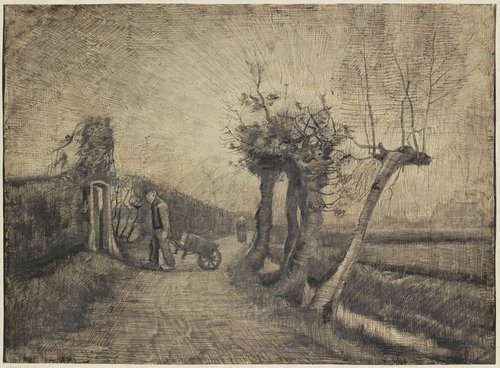
Road behind the Parsonage Garden in Nuenen
1884-03
Medium
pencil, pen and brush in brown ink
Dimensions
538; 393
Rights
Public Domain
About this artwork
height 393 mm x width 538 mm
Art Historical Context
Vincent van Gogh created *Road behind the Parson Garden in Nuenen* March 1884, his early career phase in the Netherlands. Living with his family in the Protestant parsonage in Nuenen, a small Brabant village, Van Gogh immersed himself in rural life, sketching and painting the humble landscapes and peasant scenes that surrounded him. This drawing captures a quiet dirt road winding behind the family garden, reflecting his fascination with the everyday Dutch countryside just before his shift toward bolder colors and Post-Impressionist innovation. Executed in pencil, pen, and brush with brown ink on paper (393 × 538 mm), the work showcases Van Gogh's precise yet expressive line work. The brown ink wash adds subtle tonal depth, evoking the earthy tones of his early realist style—influenced by the Hague School—while hinting at the textured, emotive drawings that would define his oeuvre. These mixed media techniques allowed for quick yet detailed studies, serving as vital preparations for his oil paintings. Housed in the Rijksmuseum, this piece offers a glimpse into Van Gogh's formative years, bridging his meticulous Dutch roots and future vibrancy. It underscores his lifelong commitment to authentic rural narratives, making it a poignant artifact for understanding the artist's evolution.
About the Artist
Vincent van Gogh · 1853–1890
Vincent Willem van Gogh (1853-1890) stands as one of the most influential figures in Western art history, despite a career spanning merely a decade. Born in Groot-Zundert, Netherlands, to a Protestant pastor's family, van Gogh's path to artistic greatness was anything but conventional. His early adulthood saw him working as an art dealer for Goupil & Cie, a language teacher, and a fervent missiona...