
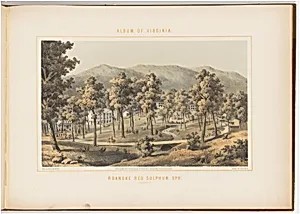
Roanoke Red Sulphur Spring
Medium
color lithograph on wove paper
Dimensions
image: 29.69 × 47.31 cm (11 11/16 × 18 5/8 in.) sheet: 45.09 × 63.34 cm (17 3/4 × 24 15/16 in.)
Classification
Department
CG-W
Museum
National Gallery of Art, Washington, D.C.
Credit
Corcoran Collection
Accession Number
2015.19.3615.39
Rights
Public Domain
Art Historical Context
This color lithograph, created in 1857 after an original work by German-born artist Edward Beyer, captures the scenic beauty of Roanoke Red Sulphur Spring, a popular 19th-century mineral spring resort in Virginia. Beyer traveled extensively through the American South in the 1850s, documenting landscapes and emerging tourist destinations with an eye for both natural detail and architectural charm. The resulting print, produced through the vibrant technique of color lithography on wove paper, allowed such views to reach a wide audience beyond the original drawing or painting. Mineral springs like this one held significant cultural importance during the antebellum period, attracting visitors who believed the waters offered restorative health benefits. Lithographs such as this one served as both souvenirs and promotional images, celebrating America’s growing leisure culture and romanticized wilderness. Now part of the National Gallery of Art’s Corcoran Collection, the work offers modern viewers a window into mid-19th-century travel, printmaking innovation, and the era’s fascination with natural wonders.