
Roller and Flat Stamps
Unknown Artist
9th–15th century
Medium
Ceramic
Dimensions
H. 4 × W. 3 1/2 × D. 2 5/8 in. (10.2 × 8.9 × 6.7 cm)
Classification
Ceramics-Implements
Culture
Manteño
Department
Arts of Africa, Oceania, and the Americas
Museum
Metropolitan Museum of Art, New York, NY
Credit
Gift of Margaret B. Zorach, 1980
Accession Number
1980.34.30
Rights
Public Domain
Art Historical Context
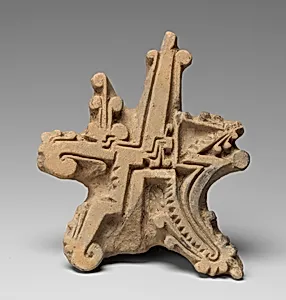
Step into the inventive world of the Manteño culture from Ecuador's Pacific coast with *Roller and Flat St*, ceramic tools dating from the 9th to 15th century. Crafted by an unknown artist, these small implements—measuring just 4 inches high—belong to the Metropolitan Museum of Art's collection of Arts of Africa,, and the Americas, by Margaret B. Zor in 1980. The Manteño people, flourishing in what is now Manabí during this late pre-Columbian era, master potters renowned for their sophisticated ceramics. These stamps exemplify practical artistry: the roller stamp, with its cylindrical form, and the flat stamp were pressed or rolled onto wet clay to imprint repeating geometric patterns, textures, or motifs before firing. This technique allowed for efficient, intricate decoration on everyday vessels and ceremonial objects, highlighting the Manteño's ingenuity in blending utility with aesthetic appeal. Such tools reveal a culture that valued precision and repetition in design, possibly echoing symbolic motifs tied to their maritime and agricultural life. Though modest in scale, these stamps offer a window into Manteño innovation, underscoring how everyday implements preserved cultural identity through generations. A testament to enduring craftsmanship, they invite us to appreciate the unsung tools behind vibrant pottery traditions. (198 words)