
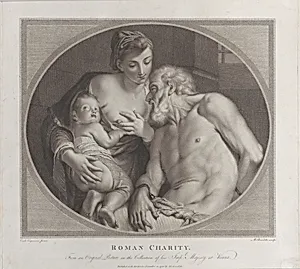
Roman Charity, with Pero, holding a small child, offering her right breast to the shackled Cimon
Medium
Stipple etching
Dimensions
Sheet (Trimmed): 15 1/2 × 17 1/8 in. (39.4 × 43.5 cm)
Classification
Prints
Department
Drawings and Prints
Museum
Metropolitan Museum of Art, New York, NY
Credit
The Elisha Whittelsey Collection, The Elisha Whittelsey Fund, 1951
Accession Number
51.501.2824
Rights
Public Domain
Art Historical Context
In the poignant print *Roman Charity, with Pero, holding a small, offering her right breast the shackled Cimon (1792), visitors encounter a dramatic retelling of an ancient Roman tale from Valerius Maximus. The scene depicts Pero nursing her imprisoned father, Cimon, condemned to starve, as an extraordinary act of filial piety. This motif, celebrated in Western art since antiquity, symbolizes selfless devotion and challenged taboos around maternity and nudity, often evoking both admiration and controversy. Created as a stipple etching by Michele Benedetti after a composition by Baroque master Carlo Cignani, the work exemplifies late 18th-century reproductive printmaking. Stipple technique—employing fine dots to build subtle tones and textures—allowed for rich, painterly effects on paper, making high-art subjects accessible to a broader audience through affordable prints. Measuring 15½ × 17⅛ inches, this trimmed sheet from The Metropolitan Museum of Art's Elisha Whittelsey Collection captures Cignani's emotive realism in intricate detail. Housed in the Drawings and Prints department, this piece highlights the enduring cultural resonance of classical virtue in the Enlightenment era, bridging Baroque grandeur with neoclassical refinement. A testament to art's power to immortalize moral heroism, it invites reflection on family bonds across millennia.
About the Artist
Carlo Cignani|Michele Benedetti · 1628–1719
Painter who continued the tradition of Bolognese classicism into the 18th century. He became the first president of the Accademia Clementina in 1711. His style is similar to that of Guido Reni. Comment on works: Mythology; Religious.