
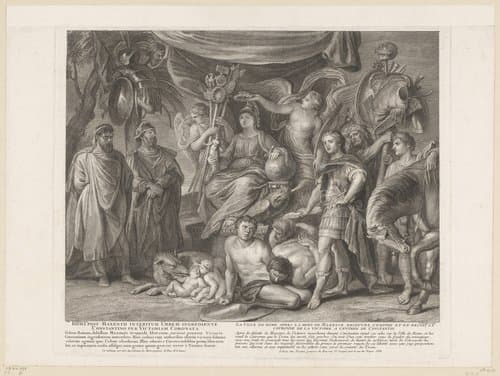
Rome ontvangt de overwinningskroon bij de aankomst van keizer Constantijn
1684 - 1749
Medium
etching
Dimensions
424; 352
Rights
Public Domain
About this artwork
collector's mark: Lugt 240
Art Historical Context
Behold *Rome ontvangt de overwinningskroon bij de aankomst van keizer Constantijn* (Rome Receives the Victory Crown upon the Arrival of Emperor Constantine), a striking etching by French engraver Nicolas Henri Tardieu (1684–1749). Measuring 352 × 424 mm, this print captures a pivotal moment in ancient Roman history: Emperor Constantine's triumphant return to Rome after his victory at the Battle of Milvian Bridge in 312 AD. Tardieu, renowned for his precise reproductive engravings, likely drew from Baroque or historical paintings to evoke the grandeur of imperial Rome. The scene symbolizes Constantine's rise to power, marking the shift toward Christianity in the empire through his famed vision and the Edict of Milan. As an etching—a meticulous intaglio technique where acid etches lines into a metal plate—Tardieu's work showcases the era's mastery of tonal depth and intricate detail, allowing for widespread dissemination of heroic narratives during the Enlightenment's fascination with antiquity. Adorned with the collector's mark Lugt 240 (associated with esteemed 19th-century collector Eugène Dutuit), this piece bridges art and provenance, inviting us to ponder how such prints preserved and popularized classical triumphs for generations of admirers.