
Romeinse beelden en bouwfragmenten uit Zeeland
1843 - 1845
Medium
lithography
Dimensions
270; 360
Rights
Public Domain
About this artwork
height 360 mm x width 270 mm
Art Historical Context
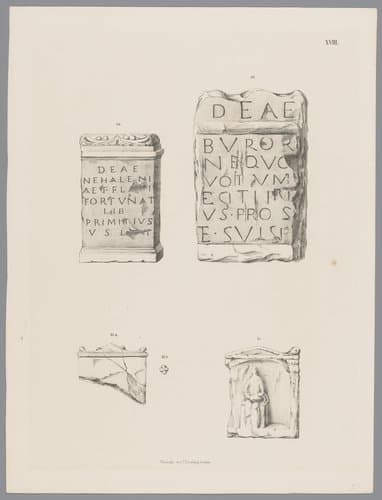
In the mid-19th century, artist Tiemen Hiberg captured a fascinating slice of ancient history with his lithograph *Romeinse beelden en bouwfragmenten uit Zeeland (Roman Statues and Building Fragments fromeland), created between 1843 and1845. Measuring 360 mm high by 270 mm wide, this detailed print showcases archaeological treasures unearthed in Zeeland, a coastal province in the Netherlands known for its Roman-era settlements. Hooiberg, a skilled lithographer, meticulously rendered statues and architectural fragments, highlighting the region's ties to the Roman Empire, which extended into the Low Countries through forts and villas around the 2nd-4th centuries AD. Lithography, Hooiberg's chosen medium, was revolutionary in the 19th century for its ability to produce affordable, high-fidelity reproductions of drawings directly from stone. This technique democratized access to antiquities, fueling the era's Romantic fascination with classical heritage and national archaeology. Amid growing Dutch interest in Roman remnants—spurred by excavations on Walcheren island—Hooiberg's work served as both artistic documentation and cultural preservation, bridging past and present for scholars and enthusiasts alike. Today, this print reminds us of Zeeland's layered history, where Roman ingenuity met marshy landscapes, offering visitors a window into how 19th-century artists revived ancient stories through innovative printmaking.