
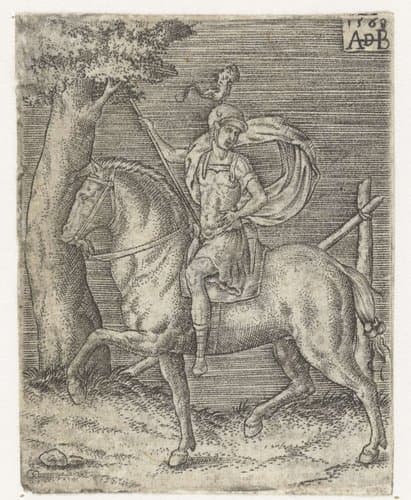
Romeinse ruiter te paard
1568
Medium
engraving
Dimensions
29; 33
Rights
Public Domain
About this artwork
blad: breedte 29 mm x hoogte 33 mm
Art Historical Context
Behold this exquisite miniature engraving *Romeinse ruiter te paard* (Roman Rider on Horseback), created by Flemish artist Abraham de Bruyn in 1568. Measuring a mere 29 mm wide by 33 mm high, this delicate print captures a mounted Roman cavalryman in full armor, evoking the grandeur of ancient legions. De Bruyn, a master engraver and publisher active in Antwerp, specialized in detailed costume studies that bridged historical revival and contemporary fascination with classical antiquity. In the Renaissance era, artists like de Bruyn drew inspiration from Roman texts and artifacts, fueling a cultural obsession with imperial military prowess amid Europe's own wars and rediscovery of classics. This work likely hails from one of his early series on historical attire, blending meticulous observation with imaginative reconstruction to educate and entertain collectors. Such prints democratized access to antiquity, appearing in books and albums that influenced fashion, theater, and even military uniforms. Engraving's fine lines allowed de Bruyn to render intricate details—horse's musculature, rider's plumed helmet, and flowing cape—in astonishing precision on this tiny scale. A testament to 16th-century printmaking ingenuity, it highlights how small-format works preserved cultural heritage for generations of scholars and enthusiasts.