
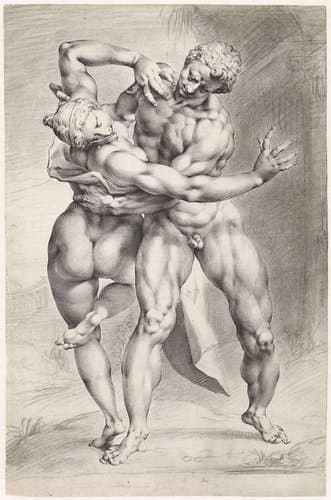
Roof van een Sabijnse vrouw
1596 - 1600
Medium
engraving
Dimensions
278; 426
Rights
Public Domain
About this artwork
height 426 mm x width 278 mm
Art Historical Context
Jan Harmensz. Muller’s engraving *Roof van een Sabijnse vrouw* (Abduction of a Sabine Woman), created between 1596 and 0, captures a dramatic moment from the ancient Roman myth in which the early Romans seized women from the neighboring Sabine tribe to secure their future. Measuring 426 by 278 mm, the large-scale print allowed for exceptional detail and was likely intended for collectors who valued reproductive engravings as affordable yet refined alternatives to paintings. As a leading Dutch engraver of the late sixteenth century, Muller worked in the international Mannerist style, translating dynamic compositions—often derived from designs by artists such as Bartholomeus Spranger—into networks of fine, swelling lines. The engraving medium, prized for its precision and ability to convey dramatic contrasts of light and shadow, made mythological narratives widely accessible across Europe during the Renaissance and early Baroque periods. This print reflects the period’s fascination with classical antiquity and the human figure in motion. Its careful technique and imposing size underscore engraving’s role in spreading both artistic innovation and humanist learning to a growing audience of educated viewers.
About the Artist
Jan Harmensz. Muller · 1571–1628
Comment on works: Printer and Draughtsman