
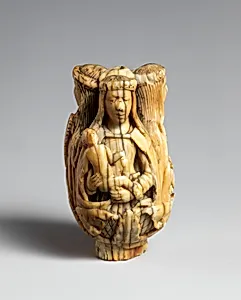
Rosary Terminal Bead with the Virgin and Child, Saint Barbara, and Saint Catherine
Unknown Artist
15th century
Medium
Ivory
Dimensions
Overall: 2 1/2 x 1 5/8 x 1 1/2 in. (6.4 x 4.2 x 3.8 cm)
Classification
Ivories
Culture
French (?)
Department
Medieval Art
Museum
Metropolitan Museum of Art, New York, NY
Credit
Gift of William H. Riggs, 1913
Accession Number
14.25.1250
Rights
Public Domain
Tags
Art Historical Context
Nestled in the Metropolitan Museum of Art's Medieval collection, this exquisite 15th-century ivory rosary terminal bead measures just 2½ x 1⅝ x 1½ inches, a testament to the miniaturist's skill. Carved by an unknown French (or French-influenced) artist, features the Virgin Mary tenderly holding the Christ Child, flanked by Saints Barbara and Catherine—powerful female figures in late medieval devotion. As the largest bead at the end of a ros strand, it served as a focal point for prayer, inviting the faithful to meditate on these holy intercessors. Ivory, a luxurious medium prized for its creamy translucency and carvability, was ideal for such portable devotional objects in Renaissance-era Europe. The three-dimensional relief captures delicate details: the Virgin's flowing robes, the saints' attributes (like Catherine's wheel and Barbara's tower), and expressive faces that evoke piety and protection. These saints were especially venerated; Barbara shielded against sudden death, while Catherine inspired scholars and maidens, reflecting the era's emphasis on personal spirituality amid the Hundred Years' War and religious reforms. Donated in 1913 by William H. Riggs, this bead highlights the intimate artistry of medieval piety, bridging sculpture and jewelry in everyday faith. Visitors, imagine fingering such a treasure during whispered prayers— a window into a devotee's heartfelt world.