
Roundel
Unknown Artist
6th–7th century
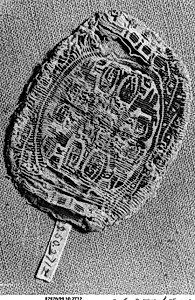
Medium
Linen, wool; tapestry weave
Dimensions
H. 4 1/4 in. (10.8 cm) W. 3 1/4 in. (8.3 cm)
Classification
Textiles
Department
Islamic Art
Museum
Metropolitan Museum of Art, New York, NY
Credit
Rogers Fund, 1909
Accession Number
09.50.2712
Rights
Public Domain
Art Historical Context
This delicate roundel, crafted by an unknown artist in the th–7th century exemplifies the exquisite textile arts of early Islamic culture. Measuring just 4¼ by 3¼ inches (10.8 by 8.3 cm), it was woven in a fine tapestry technique using linen and wool. In tapestry weave, colored weft threads completely cover the warp, creating vibrant, durable patterns ideal for decorative panels, garments, or furnishings. Such small-scale works were often applied as ornaments, highlighting the meticulous skill of ancient weavers. Dating to a pivotal era bridging late antiquity and the rise of Islam, this piece belongs to the Metropolitan Museum of Art's Islamic Art department, acquired through the Rogers Fund in 1909. Textiles like this roundel were central to daily life and trade across the early Islamic world, from Egypt to Persia, serving both practical and aesthetic purposes. Their circular form—common in Sasanian and Byzantine influences—likely framed motifs symbolizing protection or abundance, though the specific design reflects the era's blend of traditions. Today, this tiny treasure invites us to marvel at the ingenuity of anonymous artisans, whose techniques endured for centuries, preserving glimpses of a vibrant cultural heritage.