
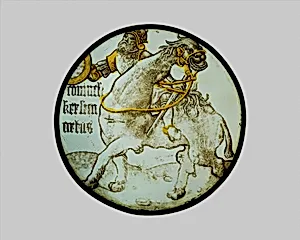
Roundel with King Arthur Riding on a Camel (from a Series of the Nine Heroes)
Unknown Artist
1500–1510
Medium
Colorless glass, vitreous paint and silver stain
Dimensions
Overall Diam.: 6 1/16 in. (15.4 cm)
Classification
Glass-Stained
Culture
North Netherlandish
Department
The Cloisters
Museum
Metropolitan Museum of Art, New York, NY
Credit
The Cloisters Collection, 1932
Accession Number
32.24.58
Rights
Public Domain
Tags
Art Historical Context
This charming roundel, created by unknown North Netherlandish around 1500–0, depicts the legendary King Arthur astride a camel, a whimsical twist on the Arthurian hero typically shown on horseback. It forms part of a rare series illustrating the "Nine Worthies" or "Nine Heroes," a medieval celebrating exemplary figures of valor: three pagans, three Jews, and three, including Arthur as the Christian exemplar alongside Charlemagne and Godfrey of Bouillon. Such panels adorned domestic windows or private chapels, blending chivalric romance with moral instruction for late medieval audiences. Crafted from colorless glass with vitreous paint for outlines and details, and silver stain for luminous yellow tones, the roundel exemplifies advanced Netherlandish stained glass techniques of the early 16th century. The silver stain, developed in the 14th century, allowed artists to achieve rich golds without colored glass, firing the metallic oxide directly into the surface for a glowing effect visible from both sides—perfect for illuminating interiors with candlelight or sun. Housed in The Cloisters at the Metropolitan Museum of Art (The Cloisters Collection, 1932), this 6-inch gem offers a window into Northern Renaissance artistry and the enduring fascination with King Arthur in European culture, where even a camel ride underscores his exotic, heroic allure.