
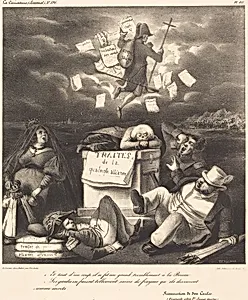
Résurrection de don Carlo...
1830s
Medium
lithograph
Dimensions
overall: 36.5 x 27 cm (14 3/8 x 10 5/8 in.)
Classification
Department
CG-E
Museum
National Gallery of Art, Washington, D.C.
Credit
Gift of Frank Anderson Trapp
Accession Number
2002.57.35
Rights
Public Domain
Art Historical Context
Benjamin Roubaud's *Résurrection de don Carlo*, a lithograph from the 183s, captures the dramatic of Romantic-era storytelling through its evocative title, suggesting a theatrical resurrection scene—likely inspired by historical or literary figures like Don Carlos, the ill-fated Spanish prince from Schiller's play. Created during a time of political upheaval in Europe, including the July Revolution of 1830 in France, the print reflects the era's fascination with heroism, tragedy, and revival themes popular in opera and theater. As a master lithographer, Roubaud exploited the medium's revolutionary potential: invented just decades earlier, lithography allowed artists to draw directly on stone with greasy crayon, producing rich tonal gradations and intricate details far superior to earlier print techniques. Measuring 36.5 x 27 cm, this intimate sheet exemplifies how lithography democratized art, making high-quality reproductions affordable for a growing middle-class audience eager for visual narratives. Housed in the National Gallery of Art's Prints department (gift of Frank Anderson Trapp), the work highlights Roubaud's skill in blending narrative drama with technical precision, offering visitors a window into 19th-century French graphic arts and their cultural resonance.