
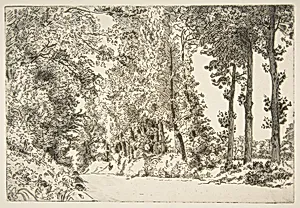
Rue des Bruyères, à Sèvres
Medium
Etching
Dimensions
Sheet: 8 7/8 × 13 7/8 in. (22.5 × 35.3 cm) Plate: 6 3/4 × 9 15/16 in. (17.2 × 25.3 cm)
Classification
Prints
Department
Drawings and Prints
Museum
Metropolitan Museum of Art, New York, NY
Credit
Rogers Fund, 1920
Accession Number
20.74.3
Rights
Public Domain
Tags
Art Historical Context
Félix Bracquemond's *Rue des Bruyères à Sèvres* (1868) captures a quiet, tree-lined street in Sèvres, a west of Paris known for its porcelain manufactory where Bracquemond himself as an engraver. This etching invites viewers into a serene everyday scene, with winding roads flanked by lush foliage, evoking the rural charm on the city's edge during France's Second Empire. Bracquemond, a pivotal figure in the 19th etching revival, blended meticulous realism with subtle atmospheric effects, influenced by his fascination with Japanese prints. As a master printmaker, Bracquemond excelled in etching—a labor-intensive intaglio technique where acid etches lines into a metal plate, allowing for fine, expressive detail. Here, the plate's modest scale (6 3/4 × 9 15/16 in.) yields intricate textures in the bark and leaves, showcasing his technical virtuosity. Acquired by The Metropolitan Museum of Art via the Rogers Fund in 1920, this work highlights the era's growing appreciation for prints as affordable art, bridging fine art and popular imagery. Bracquemond's output bridged Realism and emerging Impressionist interests in light and nature, making *Rue des Bruyères* a gem for those exploring how 19th-century artists transformed ordinary landscapes into poetic visions.
About the Artist
Félix Bracquemond · 1833–1914
French, Paris 1833–1914 Sèvres