
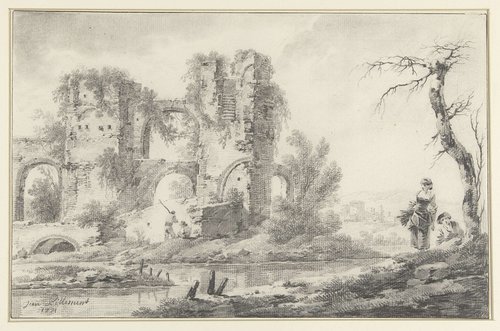
Ruïne aan een rivier met rechts een jongen en een meisje
Medium
black chalk
Dimensions
203; 317
Rights
Public Domain
About this artwork
zwart krijt
Art Historical Context
Jean-Baptiste Pillement's *Ruïne aan een rivier met een jongen en een meisje (Ruin by a River with a Boy and a Girl on the Right), in 1771, is a delicate black chalk drawing measuring 203 mm high by 317 mm wide. This intimate landscape captures a romanticized ruin beside a winding river, with a young boy and girl positioned to the right, adding a touch of human warmth to the scene. Pillement, a French Rococo artist renowned for his picturesque vignettes and decorative landscapes, often drew inspiration from nature's gentle decay, blending architectural remnants with lush foliage. Executed in black chalk—a medium Pillement favored for its subtle tonal gradations and velvety textures—this work exemplifies his mastery in evoking atmospheric depth on a small scale. The technique allows for soft shading that brings the river's flow and the ruin's weathered stones to life, characteristic of late 18th-century draftsmanship bridging Rococo elegance and emerging Romantic sensibilities. Dating to 1771, amid Pillement's travels across Europe, the drawing reflects the era's fascination with *ruinesque* motifs, symbolizing time's passage and nature's reclamation. As a preparatory study or standalone gem, it invites visitors to ponder the interplay of transience and serenity in pre-Revolutionary art.
About the Artist
Jean Baptiste Pillement · 1728–1808
In the early part of his career, he worked as a textile designer at the Gobelins factory, and as a decorative painter in Spain and Portugal. He eventually moved to London, where in 1955 he published the first of many books of Chinoiserie designs. However, he was most well-known for his prints of flowers. His popularity waned significantly when Rococo design fell out of fashion at the end of the ce...