
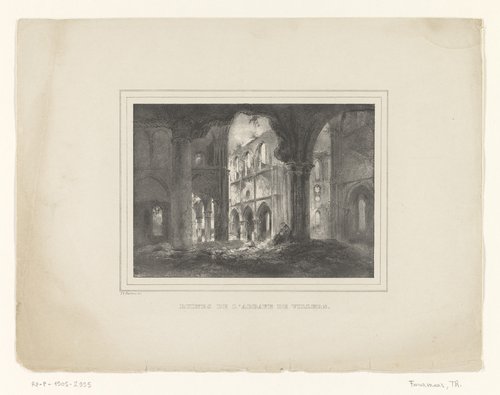
Ruines de l'abbaye de Villers
1824 - 1871
Medium
lithography
Dimensions
274; 363
Rights
Public Domain
About this artwork
blad: hoogte 274 mm x breedte 363 mm
Art Historical Context
**Ruines de l'abbaye de Villers** is a captivating lithography by Belgian artist Théodore Fourmois (1824–1871), measuring 274 mm high by 363 mm wide. Fourmois, a master of Romantic landscape painting, specialized in evoking the sublime beauty of nature reclaiming human-made structures. This print depicts the evocative ruins of Villers Abbey, a 12th-century Cistercian in Belgium's Brabant region, abandoned after the French Revolution and left to the mercy of ivy and time. Fourmois' work reflects the Romantic fascination with decay and nostalgia, blending meticulous detail with atmospheric mood. Trained in Brussels, he drew inspiration from 17th-century Dutch masters like Jacob van Ruisdael, rendering foliage, stonework, and light with precision that belies lithography's reproductive nature. This medium, invented in the late 18th century, allowed artists like Fourmois to disseminate intricate drawings affordably, bridging fine art and popular print culture during Belgium's 19th-century cultural renaissance. As a window into Belgium's medieval heritage amid industrial change, the piece invites visitors to ponder transience—much like the abbey itself, now a cherished ruin symbolizing spiritual and architectural endurance. A gem for Romantics and history buffs alike!
About the Artist
Théodore Fourmois · 1814–1871
Théodore Fourmois (1814–1871) was a pioneering Belgian landscape painter and printmaker who played a crucial role in liberating Belgian art from academic conventions and establishing a distinctly Belgian tradition of plein air landscape painting. Born in Presles in 1814 and dying in Ixelles in 1871, Fourmois bridged the Romantic and Realist movements in Belgian art, combining emotional responsiven...