
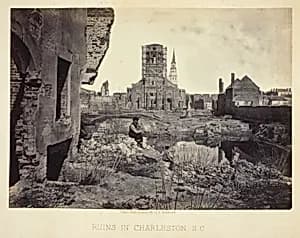
Ruins in Charleston, S.C.
1865/66
Medium
Albumen print, plate 60 from the album "Photographic Views of the Sherman Campaign" (1866)
Dimensions
Image/paper: 25.3 × 36 cm (10 × 14 3/16 in.); Album page: 41 × 50.4 cm (16 3/16 × 19 7/8 in.)
Classification
albumen silver print
Department
Photography and Media
Museum
Art Institute of Chicago
Accession Number
145558
Rights
Public Domain
Art Historical Context
"Ruins in Charleston,.C." is a poignant albumen print by George N. Barnard, captured around 1865-66 amid the aftermath of the American Civil War. As plate 60 from Barnard's seminal album *Photographic Views the Sherman Campaign* (6), it documents the devastation wrought by Union General William T. Sherman's march through the South, culminating in the of Charleston—a key Confederate port city heavily bombarded and scarred by fire. Barnard's work offers a stark visual testament to the war's toll, transforming rubble-strewn streets and shattered buildings into haunting evidence of national division and reconstruction. This 10 × 14 3/16-inch image exemplifies mid-19th-century albumen silver printing, a process using egg-white-coated paper for exceptional detail, tonal richness, and subtle gradations that brought photography into the realm of fine art. Barnard's documentary style, rooted in topographical precision, elevated war photography from mere reportage to historical preservation, influencing later photojournalism. Housed in the Art Institute of Chicago's Photography and Media department, it invites viewers to reflect on resilience amid ruin, bridging the gap between battlefield horror and postwar healing.
About the Artist
George N. Barnard · 1819–present
George N. Barnard (1819–1902) was a pioneering American photographer whose six-decade career spanned the dawn of the medium, from daguerreotypes to Civil War documentation. Born into a farming family in Coventry, Connecticut, on December 23, 1819, he lost his father at age seven and apprenticed in family businesses before marrying in 1843 and relocating to Oswego, New York. There, he launched one ...