
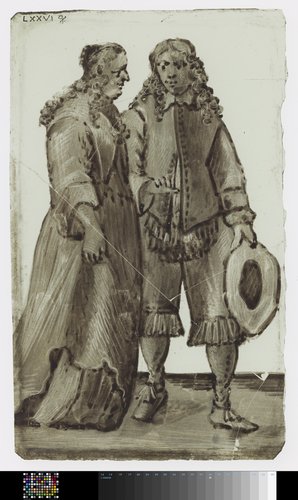
Ruit met man en vrouw
c. 1650 - c. 1675
Medium
glass
Dimensions
14.1; 8.6
Rights
Public Domain
About this artwork
grisailleverf op glas
Art Historical Context
**Ruit met man en vrouw (Lozenge with Man and Woman)** This delicate glass panel, created anonymously around 1650–1675 the Dutch Golden Age, just 14.1 cm high by 8.6 cm wide—perfect for a small window or decorative insert in a prosperous burgher's home. Titled *Ruit met man en*, or "Lozenge with Man and," it captures an intimate scene of a couple, rendered in the refined technique of *grisailleverf op glas* (grisaille paint on glass). Grisaille, using subtle shades of gray, mimics the illusion of sculpture, allowing light to filter through and create a luminous, three-dimensional effect that dances with daylight. In the 17th-century Netherlands, such painted glass panes were prized for their versatility, adorning leaded windows in taverns, homes, or guild halls. This anonymous work exemplifies the era's mastery of optical illusion and everyday portraiture, possibly evoking marital harmony or social companionship—a common motif in Dutch genre scenes. Though small, its preservation highlights the artistry of skilled glass painters, whose techniques rivaled oil on canvas in sophistication. Visitors, imagine this glowing softly in a historic Amsterdam interior, bridging art and architecture in a golden age of innovation.
About the Artist
anonymous
In the vast tapestry of art history, "Anonymous" stands not as a singular individual but as a collective designation for countless unidentified creators whose works have endured across millennia. These artists, spanning prehistoric cave painters to medieval illuminators and folk craftsmen, produced the foundational layers of human visual culture. Prior to the Renaissance, when individual fame emer...