
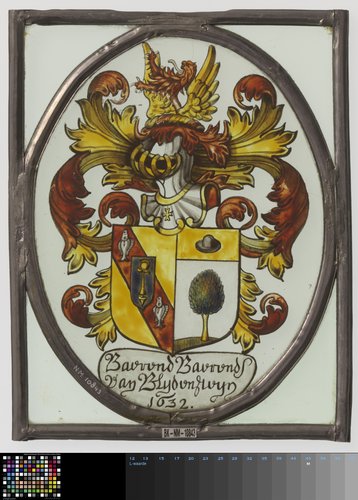
Ruit met wapenschild en tekst "Baerend Baerends van Blijdensteijn 1632"
1632
Medium
leading
Dimensions
21.5; 17.2
Rights
Public Domain
About this artwork
hoogte 21,5 cm (met lood) x breedte 17,2 cm (met lood)
Art Historical Context
This charming leaded glass pane, titledRuit met wapens en tekst "Baerend Baerends van Bdensteijn 1632"*, dates to 1632 and measures a modest 21.5 cm high by 17.2 cm wide, its lead framing. Created by an anonymous artist, it a coat of arms emblazoned the inscription honoring Baerend Baerends vanlijdensteijn, a commemorative piece for a prominent individual from the Dutch Golden Age. Such small-scale heraldic windows were prized possessions, often displayed in homes, civic halls, or churches to signify family lineage, status, or benevolence. Leaded glass technique, where vibrant colored segments are meticulously joined by H-shaped lead strips soldered at the joints, was a medieval craft perfected in the Netherlands by the 17th century. This method not only ensured durability but allowed for intricate designs that caught the light beautifully, transforming spaces with jewel-like glows. The compact size suggests it may have been part of a larger window or a personal keepsake, reflecting the era's booming glass industry in places like Leiden and Amsterdam. Culturally, these panels underscore the importance of heraldry in Dutch society, where burghers emulated nobility through armorial displays. Dating to 1632—a peak of prosperity amid trade and tulip mania—this artifact offers a glimpse into personal pride and the artistry of everyday commemoration, inviting us to ponder the life of its namesake.
About the Artist
anonymous
In the vast tapestry of art history, "Anonymous" stands not as a singular individual but as a collective designation for countless unidentified creators whose works have endured across millennia. These artists, spanning prehistoric cave painters to medieval illuminators and folk craftsmen, produced the foundational layers of human visual culture. Prior to the Renaissance, when individual fame emer...