
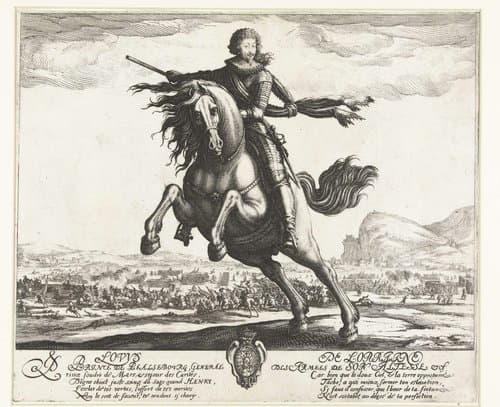
Ruiterportret van Lodewijk de Guise, prins van Phalsbourg
1621 - 1624
Medium
etching
Dimensions
340; 286
Rights
Public Domain
About this artwork
blad: hoogte 286 mm x breedte 340 mm
Art Historical Context
**Ruiterportret Lodewijk de Gu, prins van Phals** (Equestrian Portrait of Louis de Guise, Prince of Phbourg) is a striking etching by Jacques Callot, created between 1621 and1624. Measuring 286 mm high by 340 mm wide, this print captures the nobleman in dynamic equestrian pose, a format favored by European aristocracy to symbolize power, military prowess, and refined horsemanship. Louis de Guise, a prominent of the influential House of Guise and Prince of Phalsbourg in Lorraine, embodies the turbulent nobility of early 17th-century France amid the Thirty Years' War's early stirrings. Callot, a Baroque master printmaker from Nancy, revolutionized etching with his innovative techniques, such as the use of multiple biting stages and fine, expressive linework. This allowed unprecedented detail in costumes, armor, and horse anatomy on a relatively intimate scale. Working as court artist to the Dukes of Lorraine, Callot produced such portraits to celebrate patrons like de Guise, blending realism with dramatic flair. As an affordable multiple via etching, the work extended elite portraiture beyond oil paintings, influencing print culture across Europe. Visitors will appreciate its intricate craftsmanship—a testament to Callot's genius in capturing fleeting movement and grandeur on paper.
About the Artist
Jacques Callot · 1592–1635
Jacques Callot (1592–1635) was a French printmaker and draftsman from the Duchy of Lorraine, widely regarded as one of the first great artists to practice the graphic arts exclusively. His more than 1,400 etchings chronicled the breadth of 17th-century life, from Medici court festivities to the brutal realities of warfare. Callot revolutionized etching through technical innovations including the é...