
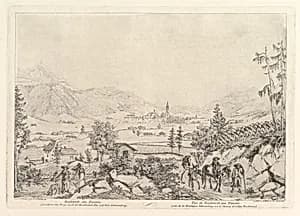
Rural Landscape, "Radstadt am Tauren"
early 19th century
Medium
Etching; second state
Dimensions
plate: 7 3/4 x 11in. sheet: 11 5/8 x 15 7/8 in.
Classification
Prints
Department
Drawings and Prints
Museum
Metropolitan Museum of Art, New York, NY
Credit
Harris Brisbane Dick Fund, 1931
Accession Number
31.86.6
Rights
Public Domain
Tags
Art Historical Context
This etching, titled *Rural Landscape, "Radstadt am Tauren,"* captures a serene alpine scene from the early nineteenth century. Created by Johann Christoph Erhard in collaboration with C. Viehbeck, the print depicts a tranquil village setting with clustered houses, towering trees, figures tending horses amid rolling hills. Likely representing the Austrian town of Radstadt in the Tauern mountains, the work reflects the period’s growing fascination with unspoiled nature and rural life. As an etching in its second state, the piece showcases the medium’s ability to render fine details and atmospheric depth through delicate linework and tonal variation. Etchings like this allowed artists to reproduce intricate landscapes for wider audiences, bridging the gap between original drawings and accessible art. The composition balances human presence with the grandeur of the natural environment, inviting viewers to appreciate both the everyday rhythms of village life and the majestic surroundings. Acquired by the Metropolitan Museum of Art in 1931 through the Harris Brisbane Dick Fund, this print belongs to the museum’s renowned Drawings and Prints collection. It offers a window into early Romantic sensibilities, where artists celebrated the quiet poetry of the countryside.
About the Artist
Johann Christoph Erhard|C. Viehbeck · 1795–1822
Johann Christoph Erhard (1795–1822) was a German painter and etcher of the Romantic era whose sensitive landscape studies and skillful prints earned him a growing reputation before his tragically early death at twenty-six. Born in Nuremberg, he studied at the Nuremberg Academy and later in Munich, where he was influenced by the Romantic landscape tradition and the revival of interest in the art of...