
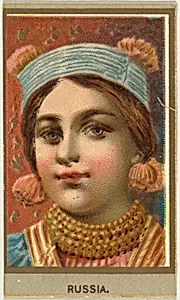
Russia, from the Races of Mankind series (T181) issued by Abdul Cigarettes
1881
Medium
Commercial color lithograph
Dimensions
Sheet: 2 3/8 × 1 3/8 in. (6 × 3.5 cm)
Classification
Prints|Ephemera
Department
Drawings and Prints
Museum
Metropolitan Museum of Art, New York, NY
Credit
The Jefferson R. Burdick Collection, Gift of Jefferson R. Burdick
Accession Number
63.350.246.181.31
Rights
Public Domain
Tags
Art Historical Context
This small commercial color lithograph, issued in 1881 by Abdul Cigarettes as part of its “Races of Mankind” series (T181), offers a vivid glimpse into late-nineteenth-century popular culture. Measuring just 2 3/8 by 1 3/8 inches, the card was designed to be tucked into cigarette packs, encouraging collectors to assemble complete sets while they smoked. The image depicts a woman representing Russia, reflecting the era’s fascination with classifying peoples by perceived racial and national types—an interest shared by anthropologists, advertisers, and the public alike. Color lithography, a relatively new technology at the time, allowed manufacturers to produce bright, affordable images on a massive scale. What might appear today as simple ephemera was once a novel way to bring colorful “educational” pictures into everyday life. The card’s presence in the Metropolitan Museum’s Jefferson R. Burdick Collection underscores how such humble printed materials now help us understand nineteenth-century attitudes toward geography, identity, and visual culture. Though modest in size, the print captures both the commercial ingenuity and the complex social ideas of its moment, inviting viewers to consider how images once used for advertising continue to shape our view of history.
About the Artist
Abdul Cigarettes · 1881–1881
Abdul Cigarettes, an enigmatic American entity active solely in 1881, stands as a fascinating footnote in the history of commercial art, best known for producing vibrant chromolithograph trade cards inserted into cigarette packages as promotional inserts. Little is documented about its origins or personnel, suggesting it operated as a short-lived publishing venture rather than the work of a singul...