
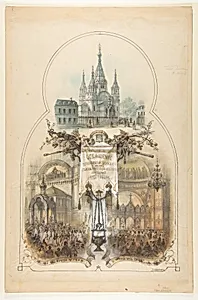
Russian Orthodox Cathedral, Paris
19th century
Medium
Pen and black and brown ink, brush and brown, gray, and blue/green wash, gouache, over graphite
Dimensions
sheet: 20 3/16 x 13 7/16 in. (51.2 x 34.2 cm)
Classification
Drawings
Department
Drawings and Prints
Museum
Metropolitan Museum of Art, New York, NY
Credit
The Elisha Whittelsey Collection, The Elisha Whittelsey Fund, 1966
Accession Number
66.622.26
Rights
Public Domain
Tags
Art Historical Context
This exquisite 19th-century drawing the majestic Russian Orthodox Cathedral in Paris a striking symbol of cultural exchange between Russia and France. Created by an anonymous French artist, it depicts the cathedral amid a bustling crowd, evoking the expatriate community that flourished in the French capital during the era. Paris had become a hub for Russian nobility, artists, and intellectuals by the mid-1800s, and this architectural marvel—likely the Alexander Nevsky Cathedral consecrated in 1861—served as their spiritual heart, blending bulbous onion domes and ornate Byzantine details with the Parisian skyline. The artwork's historical significance lies in its snapshot of 19th-century cosmopolitanism, highlighting how Orthodox traditions took root in the West amid political upheavals like the Napoleonic Wars and later Russian reforms. Rendered on a generous sheet (20 3/16 x 13 7/16 in.), it showcases meticulous French draftsmanship, starting with graphite underdrawing for precision, then layered with pen and ink for sharp lines, brush washes in brown, gray, and blue-green for atmospheric depth, and gouache for luminous highlights. As part of The Metropolitan Museum of Art's Elisha Whittelsey Collection, this mixed-media drawing exemplifies the era's topographic tradition, blending technical virtuosity with cultural narrative to transport viewers to a lively scene of faith and gathering.
About the Artist
Anonymous, French, 19th century · 1800–1900
**Anonymous, French, 19th Century (ca. 1800–1900)** The artist cataloged as Anonymous, French, 19th century embodies the enigmatic yet essential contributions of unidentified creators to France's vibrant 19th-century art world. Active roughly between 1800 and 1900, this figure—or potentially collective workshop—produced a diverse array of works amid the nation's transition from Neoclassicism thro...