
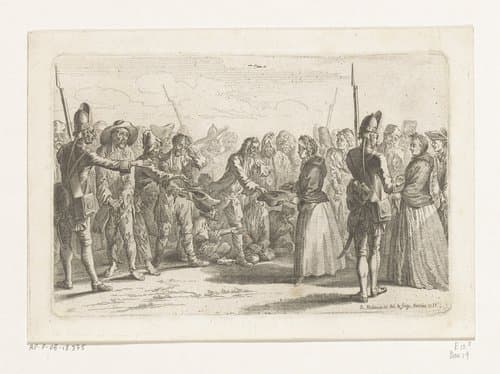
Russische krijgsgevangenen in Berlijn, 1758
Medium
etching
Dimensions
110; 168
Rights
Public Domain
About this artwork
height 110 mm x width 168 mm
Art Historical Context
Daniel Nikolaus Chodowiecki's etching *Russische krijgsgevangenen in Berlijn, 1758* captures a poignant moment from the Seven Years' War, depicting Russian prisoners of war paraded through the streets of Berlin. Created in the very year of the scene, this small-scale work (110 mm × 168 mm) exemplifies Chodowiecki's mastery as a leading 18th-century German engraver and illustrator, known for his lively, detailed vignettes of contemporary life and historical events. Working in Berlin under Prussian patronage, he blended Rococo elegance with Enlightenment realism, producing affordable prints that reached wide audiences. The etching's subject reflects the brutal realities of the global conflict (1756–1763), where Prussia, led by Frederick the Great, clashed with a coalition including Russia. After key victories like Zorndorf in 1758, captured Russian soldiers became spectacles in Berlin, symbolizing Prussian resilience amid wartime hardships. Chodowiecki's technique—fine lines and tonal shading via etching on copper plate—conveys the prisoners' weary expressions and the curious crowds, evoking empathy and national pride. As a reproducible medium, etchings like this served as early "news images," disseminating war narratives and fostering public discourse. This piece offers visitors a window into 18th-century Europe's turmoil, highlighting Chodowiecki's role in visual journalism.
About the Artist
Daniel Nikolaus Chodowiecki · 1726–1801
Daniel Nikolaus Chodowiecki (1726–1801) was a German painter and printmaker of Polish-Huguenot descent who became the most celebrated graphic artist in 18th-century Germany. Born in Danzig (now Gdańsk), he created approximately 2,000 etchings that serve as an invaluable visual record of German bourgeois life during the Enlightenment. Largely self-taught, Chodowiecki moved to Berlin in 1743 and ach...