
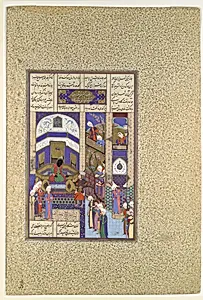
"Rustam Blames Kai Kavus for the Death of Siyavush", Folio 202v from the Shahnama (Book of Kings) of Shah Tahmasp
ca. 1525–30
Medium
Opaque watercolor, ink, silver, and gold on paper
Dimensions
Painting: H. 11 1/8 in. (28.3 cm) W. 7 1/4 in. (18.4 cm) Page: H. 18 11/16 in. (47.5 cm) W. 12 9/16 in. (31.9 cm) Mat: H. 22 in. (55.9 cm) W. 16 in. (40.6 cm)
Classification
Codices
Department
Islamic Art
Museum
Metropolitan Museum of Art, New York, NY
Credit
Gift of Arthur A. Houghton Jr., 1970
Accession Number
1970.301.30
Rights
Public Domain
Tags
Art Historical Context
This exquisite folio, titled "Rustam Blames Kaius for the Death ofavush," comes from the renowned *Shahnama* (Book of Kings) of Tahmasp, the Persian national epic composed by the poet Abu'l Qasim Firdausi around1010. Dating to circa 1525–30, it captures a pivotal moment of confrontation: the legendary hero Rustam rebukes King Kai Kavus for the tragic death of the innocent prince Siyavush, highlighting themes of justice, betrayal, and royal folly central to Persian mythology. Created during the Safavid dynasty in Tabriz, this painting by masters Qadimi and Mir Musavvir exemplifies the pinnacle of Persian miniature art. The medium—opaque watercolor, ink, silver, and gold on paper—brings vibrant intensity to the scene, with luminous golds and silvers evoking divine light and royal splendor. Measuring about 11 by 7 inches for the painting itself, the folio's intricate details, dynamic compositions, and flattened perspective create a timeless narrative space, blending text and image in a codex format typical of Islamic manuscripts. Housed in the Metropolitan Museum of Art's Islamic Art Department, this work from the lavish *Shahnama* of Shah Tahmasp—commissioned by the Safavid ruler himself—underscores the cultural prestige of Persian epics. It reflects the era's artistic patronage, where illuminated manuscripts preserved heroic legends for elite audiences, influencing centuries of Islamic book arts. A gift of Arthur A. Houghton Jr. in 1970, it invites visitors to ponder the enduring drama of ancient kings and warriors.
About the Artist
Qadimi|Abu'l Qasim Firdausi|Mir Musavvir (Iranian|Iranian) · 1500 |0935 –1590 |1020
Iranian, active ca. 1525–1565|Iranian, Paj ca. 940/41–1020 Tus