
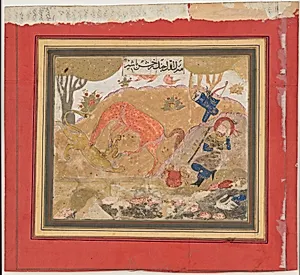
"Rustam's First Course: Rakhsh Kills a Lion", Folio from a Shahnama (Book of Kings)
ca. 1430–40
Medium
Ink, opaque watercolor, and gold on paper
Dimensions
Image: H. 9 1/2 in. (24.1 cm) W. 10 3/8 in. (26.4 cm) Page: H. 11 1/2 in. (29.2 cm) W. 12 1/4 in. (31.1 cm) Mat: H. 19 1/4 in. (48.9 cm) W. 14 1/4 in. (36.2 cm)
Classification
Codices
Department
Islamic Art
Museum
Metropolitan Museum of Art, New York, NY
Credit
The Grinnell Collection, Bequest of William Milne Grinnell, 1920
Accession Number
20.120.246
Rights
Public Domain
Tags
Art Historical Context
This stunning folio from a *Shahnama* (Book of Kings), titled *"Rustam's First Course: Rakh Kills a Lion" captures a thrilling moment from the Persian national epic composed by the poet Abu'l Qasim Firdausi around1010 CE. In the story, the heroic warrior Rustam embarks on perilous trials, and here his loyal steed Rakhsh fiercely battles a lion, showcasing bravery and the deep bond between rider and horse. Created circa 1430–40 in the Timurid era, this page reflects the golden age of Persian manuscript illumination, where epic tales of ancient Iranian kings and champions were vividly brought to life for royal patrons. Rendered in ink, opaque watercolor, and gold on paper—a hallmark of Islamic miniature painting—the artwork measures about 9½ by 10⅜ inches for the image alone. Artists employed fine-line drawing for dynamic action, vibrant colors for dramatic landscapes and figures, and gold accents to evoke splendor, all within the rectangular format of a codex page. Lions symbolize raw power in Persian lore, while bows and arrows hint at Rustam's arsenal, blending human valor with animal ferocity. Housed in the Metropolitan Museum of Art's Islamic Art Department, this folio from the Grinnell Collection highlights the *Shahnama*'s enduring cultural role: preserving pre-Islamic myths, fostering national identity, and inspiring generations through exquisite, story-driven art. A window into 15th-century Persia!
About the Artist
Abu'l Qasim Firdausi · 935–1020
Abu'l Qasim Firdausi, born around 940 in the village of Paj near Tus in Khorasan (modern-day Iran), emerged from a family of landed gentry known as dehqans, who preserved ancient Iranian oral traditions amid the cultural renaissance of the Samanid Empire. Little is documented about his early life or formal training, though he likely received a basic education including Arabic literacy, immersing h...