
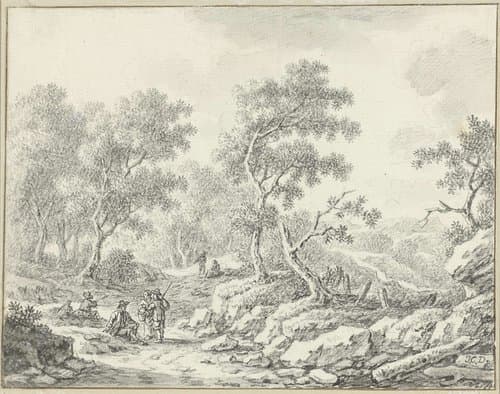
Rustende en wandelende personen in boomrijk landschap
1720 - 1769
Medium
brush
Dimensions
146; 190
Rights
Public Domain
About this artwork
Purchased with the support of the Vereniging Rembrandt
Art Historical Context
Nestled in a lush, tree-filled landscape, Johann Christoph Dietsch's *Rustende en wandelende in boomrijk landschap (Resting and Walking in a Wooded Landscape captures a serene moment of everyday life from the 18th century Created between 1720 and 1769, this intimate brush drawing—measuring just 146 × 190 mm—dep figures pausing amid nature, evoking the Rococo era's delight in pastoral idylls harmonious human-nature interactions. Dietzsch, a Nuremberg-based German artist known for his delicate engravings and landscapes, skillfully rendered foliage and figures with fluid brushwork, blending realism with whimsical lightness. The artwork's modest scale highlights its likely role as a preparatory study or collector's gem, showcasing Dietzsch's mastery of brush techniques in monochrome or light wash, which allowed for nuanced tonal depth on a small surface. Rooted in the Baroque-to-Rococo transition, it reflects Central European tastes for romanticized countryside scenes, influenced by Dutch Golden Age landscapes that Dietzsch admired. Acquired with support from the Vereniging Rembrandt—a Dutch foundation championing art preservation—this piece underscores its enduring cultural value, bridging German draftsmanship with Northern European collections for modern audiences to savor.
About the Artist
Johann Christoph Dietzsch · 1710–1768
Comment on works: Landscapes; Flowers; Fruit; Still life; Fruit; Kitchen pieces