
Ryde Pier
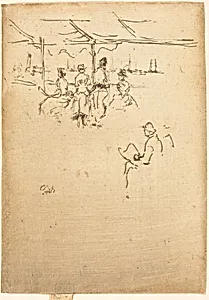
Medium
etching on laid paper
Dimensions
overall (trimmed to plate): 13.2 × 9.3 cm (5 3/16 × 3 11/16 in.)
Classification
Department
CG-W
Museum
National Gallery of Art, Washington, D.C.
Credit
Rosenwald Collection
Accession Number
1943.3.8611
Rights
Public Domain
Art Historical Context
James McNeill Whistler, renowned American-born artist active in Britain, captured the serene English seaside in *Ryde Pier* (1887), an intimate etching on laid paper measuring just 13.2 × 9.3 cm. Created during a period when Whistler was deeply engaged in printmaking, this work reflects his fascination with coastal scenes on the Isle of Wight. As a leader in the Aesthetic Movement, Whistler prioritized "art for art's sake," emphasizing and harmony over narrative, much like his famous nocturnes in oil. Etching allowed Whistler to achieve exquisite tonal subtlety through aquatint and drypoint techniques, bitten into a metal plate with acid to produce rich, velvety blacks and delicate whites on the textured laid paper. Trimmed precisely to the plate's edge, the composition draws viewers into the pier's atmospheric expanse, evoking the fleeting light and sea mist of late Victorian Britain. This small-scale print exemplifies the 19th-century Etching Revival, where artists like Whistler elevated printmaking to fine art. Housed in the National Gallery of Art's Rosenwald Collection, *Ryde Pier* showcases Whistler's technical mastery and enduring influence on modern printmakers. Visitors can appreciate how this modest gem distills the beauty of everyday landscapes into poetic elegance, inviting quiet contemplation of nature's subtle rhythms.
About the Artist
James McNeill Whistler · 1834–1903
James Abbott McNeill Whistler (1834-1903) was an American-born painter and printmaker who became a leading figure in the Aesthetic Movement and pioneer of Tonalism and Japonisme. He revolutionized art by championing "art for art's sake" and treating paintings as visual equivalents of musical compositions, titling works as "arrangements," "harmonies," and "nocturnes" to emphasize formal qualities o...