
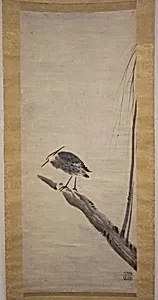
柳鷺図 (Ryūro zu)|Heron and Willow
18th–19th century
Medium
Hanging scroll; ink on paper
Dimensions
Image: 39 1/4 × 16 1/8 in. (99.7 × 41 cm) 71 1/4 × 21 in. (181 × 53.3 cm) Overall with mounting: 71 1/4 × 22 1/8 in. × 1 in. (diam. of knob) (181 × 56.2 × 2.5 cm)
Classification
Paintings
Culture & Period
Japan · Edo (1615–1868)–Meiji (1868–1912) period
Department
Asian Art
Museum
Metropolitan Museum of Art, New York, NY
Credit
Charles Stewart Smith Collection, Gift of Mrs. Charles Stewart Smith, Charles Stewart Smith Jr., and Howard Caswell Smith, in memory of Charles Stewart Smith, 1914
Accession Number
14.76.11
Rights
Public Domain
Tags
Art Historical Context
This hanging scroll, titled "Heron and Willow," was painted by Sesshū Tōyō in ink on paper during Japan’s Edo (1615–1868) to Meiji (1868–1912) periods. The medium allowed the artist to explore subtle gradations of black ink, creating a sense of depth and movement with minimal strokes. As a hanging scroll, the work was designed to be viewed in a domestic or temple setting, where it could be changed with the seasons to enhance the viewer’s connection to nature. The subject—a heron resting among willow branches—reflects the long-standing Japanese appreciation for birds as symbols of grace and transience. Sesshū’s brushwork captures the delicate interplay between the bird’s poised form and the flowing lines of the willow, demonstrating the economy and expressive power of ink painting traditions. Acquired by the Metropolitan Museum of Art in 1914 as part of the Charles Stewart Smith Collection, the scroll continues to illustrate how Japanese artists used simple materials to evoke contemplative harmony with the natural world.