
S. Rocco
probably c. 1754/1765
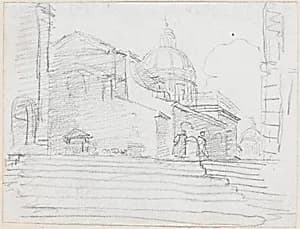
Medium
black chalk on laid paper
Dimensions
Overall: 10.3 x 13.6 cm (4 1/16 x 5 3/8 in.) support: 15.6 x 21.5 cm (6 1/8 x 8 7/16 in.)
Classification
Drawing
Department
CG-E
Museum
National Gallery of Art, Washington, D.C.
Credit
Julius S. Held Collection, Ailsa Mellon Bruce Fund
Accession Number
1984.3.41
Rights
Public Domain
Art Historical Context
Hubert Robert, the 18th-century French artist often called "Robert des Ruines" for his evocative depictions of ancient architecture and landscapes, created this intimate drawing titled *S.* around 1754–1765. Executed in black chalk on laid paper—a medium favored for its subtle tonal range and portability—this small sheet (10.3 × 13.6 cm) Robert's early mastery during his formative years in Rome, where he immersed himself in Italy's classical heritage from 1754 to 1764. The work likely evokes the Church of San Rocco, a Baroque landmark in Venice or a similar devotional site, reflecting Robert's fascination with weathered grandeur and atmospheric light. Black chalk allowed him to model soft shadows and textures, techniques honed in plein-air sketching that informed his later oil paintings of imaginary ruins blending neoclassical precision with romantic decay. As a preparatory study or standalone gem, it showcases his veduta style—inspired by contemporaries like Piranesi—bridging architecture and emotion. Housed in the National Gallery of Art's Julius S. Held Collection (Ailsa Mellon Bruce Fund), this drawing offers visitors a window into Robert's youthful genius, highlighting how 18th-century draftsmen transformed fleeting observations into timeless visions of cultural memory.
About the Artist
Hubert Robert · 1733–1808
Hubert Robert, born on May 22, 1733, in Paris, emerged from a modest background; his father, Nicolas Robert, served the influential Choiseul family, whose patronage shaped the young artist's path. After completing his studies at the Jesuit Collège de Navarre in 1751, he entered the atelier of sculptor Michel-Ange Slodtz, who taught him design and perspective before encouraging a shift to painting....