
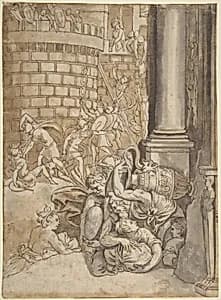
Sack of a City
1499–1543
Medium
Pen and brown ink, brushed and washed with brown and gray, over charcoal
Dimensions
11 x 8 in. (27.6 x 20.4 cm)
Classification
Drawings
Department
Drawings and Prints
Museum
Metropolitan Museum of Art, New York, NY
Credit
Gift of Cornelius Vanderbilt, 1880
Accession Number
80.3.65
Rights
Public Domain
Tags
Art Historical Context
Behold the dramatic *Sack of a City*, a masterful drawing by Polidoro da Caravaggioc. 1499–1543), a key figure in the Roman High Renaissance and early Mannerism. Trained under Raphael, Polidoro gained fame for his innovative frescoes adorning Rome's Palazzo Farnese with classical motifs and dynamic figures. This intimate sheet, executed in pen and brown ink with brushed brown and gray washes over charcoal captures the chaos of urban plunder through swirling soldiers, fleeing men, and desperate women—evoking the brutal sieges of the Italian Wars that ravaged Europe in the early 16th century. The mixed-media technique exemplifies Renaissance draftsmanship: charcoal sketches fluid forms, while ink lines and subtle washes build depth and shadow, heightening emotional intensity. At just 11 x 8 inches, it served likely as a compositional study or independent work, showcasing Polidoro's skill in conveying movement and pathos in miniature scale. Such drawings were prized by collectors for their raw energy and narrative power. A generous gift from Cornelius Vanderbilt in 1880, this piece resides in the Metropolitan Museum of Art's Drawings and Prints department, offering visitors a window into the era's turmoil and artistic innovation. Step closer to feel the frenzy!
About the Artist
Polidoro da Caravaggio · 1492–present
Polidoro Caldara, known as Polidoro da Caravaggio, was born around 1499 in Caravaggio, Lombardy, and emerged as one of the most innovative painters of the early Mannerist period. Arriving in Rome circa 1515 as an untrained laborer hauling plaster for the Vatican Logge decorations, he quickly caught the eye of Raphael's key assistant, Maturino da Firenze. By 1517, Polidoro had joined Raphael's work...