
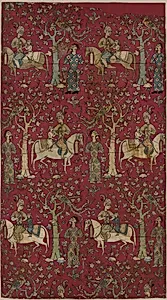
Safavid Courtiers Leading Georgian Captives
Unknown Artist
mid-16th century
Medium
Silk, metal wrapped thread; lampas
Dimensions
Textile: L. 47 1/2 in. (120.7 cm) W. 26 1/2 in. (67.3 cm) Mount: L. 53 in. (134.6 cm) W. 32 1/8 in. (81.6 cm) D. 1 in. (2.5 cm) Wt. 31 lbs. (14.1 kg)
Classification
Textiles-Woven
Department
Islamic Art
Museum
Metropolitan Museum of Art, New York, NY
Credit
Purchase, Joseph Pulitzer Bequest, 1952
Accession Number
52.20.12
Rights
Public Domain
Tags
Art Historical Context
This exquisite mid-16th-century textile from the Safavid court captures a vivid scene of courtiers leading Georgian captives, rendered in luxurious silk and metal-wrapped threads. Created during the height of the Safavid Empire in Iran, the work reflects the era’s political dynamics, including military campaigns and interactions with neighboring regions like Georgia. As a woven lampas fabric—a sophisticated technique that combines multiple layers to create rich patterns and textures—it would have adorned royal garments or furnishings, underscoring the wealth and refinement of the Safavid court. The composition features men on horseback amid trees, birds, and children, blending narrative storytelling with decorative elements typical of Persian textiles. These details not only document historical events but also celebrate the empire’s artistic traditions, where woven art served both practical and symbolic purposes. Housed in the Metropolitan Museum of Art’s Islamic Art collection, this piece highlights the cultural significance of textiles as portable expressions of power and diplomacy in the early modern Islamic world. Its intricate craftsmanship invites viewers to appreciate the skill of anonymous weavers who transformed silk into enduring historical records.