
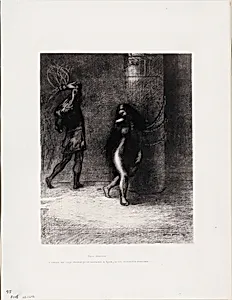
Saint Anthony: "Beneath her long hair, which covered her face, I thought I recognized Ammonaria", plate 1 of 6
1889
Medium
Lithograph in black on ivory China paper laid down on ivory wove paper
Dimensions
Image/chine: 28.8 × 23.1 cm (11 3/8 × 9 1/8 in.); Sheet: 44.9 × 34.5 cm (17 11/16 × 13 5/8 in.)
Classification
lithograph
Department
Prints and Drawings
Museum
Art Institute of Chicago
Accession Number
79466
Rights
Public Domain
Art Historical Context
Odilon Redon's haunting lithograph *Saint Anthony: "Bene her long hair, which her face, I thought recognized Ammonaria"* (9) is the first plate in a series of six inspired by Gustave Flaubert's novel *The Temptation Saint Anthony*. This Symbolist masterpiece captures a pivotal of ethereal recognition amid the saint's spiritual trials, blending mysticism and hallucination in a dreamlike tableau. Redon, a French artist pivotal to the Symbolist movement, drew from literary sources to explore the subconscious, moving beyond realism toward the fantastical. Printed in black ink on delicate ivory China paper laid down on ivory wove paper (image: 28.8 × 23.1 cm), the work showcases Redon's mastery of lithography—a technique he championed in his early "noirs" for its velvety textures and subtle gradations. The monochromatic palette evokes mystery and introspection, with soft edges and shadowy depths that immerse viewers in Anthony's otherworldly visions. Produced during a period when Redon transitioned from charcoal drawings to prints, this piece reflects late 19th-century fascination with psychology and the unseen. Housed in the Art Institute of Chicago's Prints and Drawings Department, it exemplifies how Redon's innovative prints bridged Romanticism and modernism, influencing Surrealists like Max Ernst. A captivating gateway to Symbolism's poetic depths.
About the Artist
Odilon Redon · 1840–1916
Odilon Redon (1840-1916) was a French Symbolist painter, printmaker, and pastellist whose visionary art bridged the 19th-century Symbolist movement and 20th-century Surrealism. Born Bertrand Redon in Bordeaux on April 20, 1840, he earned the nickname "Odilon" from his mother Odile. His father, who made his fortune in the Louisiana slave trade, conceived Odilon in New Orleans before the family retu...