
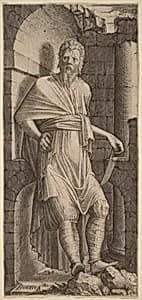
Saint Bartholomew
c. 1548
Medium
engraving on laid paper
Classification
Department
CG-E
Museum
National Gallery of Art, Washington, D.C.
Credit
Ailsa Mellon Bruce Fund
Accession Number
1974.34.4
Rights
Public Domain
Art Historical Context
Created around 1548, Lambert Suavius’s engraving *Saint Bartholomew* offers a striking example of mid-sixteenth-century printmaking. As a reproductive medium, engraving allowed artists to circulate devotional images across Europe with remarkable precision, reaching audiences far beyond the walls of churches or private chapels. Suavius, working in the Low Countries, used the technique to render the apostle with careful attention to line and texture, inviting viewers to contemplate both the saint’s martyrdom and his spiritual significance. The choice of laid paper as support further enhances the work’s delicate tonal gradations, a hallmark of engravings from this period. Such prints played an important role in shaping religious devotion and artistic exchange during the Renaissance, when the demand for affordable yet refined sacred imagery was growing. Today, *Saint Bartholomew* resides in the National Gallery of Art’s collection thanks to the Ailsa Mellon Bruce Fund, preserving this intimate encounter with a figure central to Christian tradition for contemporary audiences.
About the Artist
Lambert Suavius · 1510–1576
Lambert Suavius (c.1510–c.1574/76), whose Flemish family name was Zutman, was born in Liège, in the southern Netherlands. He was the son of an episcopal goldsmith, Henri Zutman, and from his father's craft environment he inherited a training in the precise handling of metal and an appreciation for fine detail work. He became closely associated with his brother-in-law Lambert Lombard, the leading a...