
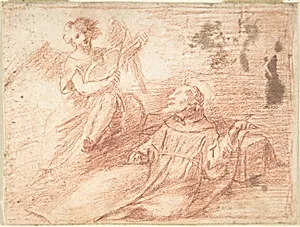
Saint Francis and an Angel with a Viola da Braccio (The Ecstasy of Saint Francis)
Medium
Red chalk; composition outlined on three sides with the same. On off-white paper
Dimensions
3-9/16 x 4-3/4 in. (9.0 x 12.0 cm)
Classification
Drawings
Department
Drawings and Prints
Museum
Metropolitan Museum of Art, New York, NY
Credit
Gift of Mr. and Mrs. William B. Jaffe, 1956
Accession Number
56.235.31
Rights
Public Domain
Tags
Art Historical Context
This delicate red chalk drawing from 17th-century Seville captures a tender moment of divine encounter. Created by an anonymous artist of the Seville School, it depicts Saint Francis of Assisi in a state of spiritual rapture, accompanied by an angel playing the viola da braccio. The small scale—just over three by four and three-quarters inches—suggests it may have served as a private devotional study or preparatory sketch, inviting intimate contemplation of the saint’s mystical experience. The choice of red chalk, or sanguine, lends the scene a warm, lifelike glow that heightens its emotional resonance. Outlined on three sides, the composition focuses attention on the gentle interaction between the kneeling saint and the celestial musician, a motif that underscores music’s role as a conduit for heavenly grace in Baroque religious art. Produced during Spain’s Golden Age, when Seville was a thriving center of Catholic devotion, the drawing reflects the era’s emphasis on personal piety and emotional connection to the divine. Such works helped viewers imagine the saints’ ecstatic visions, reinforcing faith amid the spiritual fervor of the Counter-Reformation.