
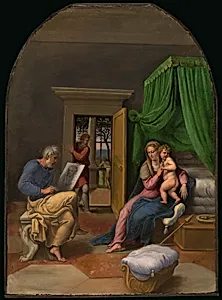
Saint Luke Drawing the Virgin and Christ Child
c. 1535
Medium
Oil on panel
Dimensions
47 × 34 cm (18 9/16 × 13 7/16 in.); Framed: 69.6 × 57.2 × 5.8 cm (27 3/8 × 22 1/2 × 2 1/4 in.)
Classification
painting
Department
Painting and Sculpture of Europe
Museum
Art Institute of Chicago
Accession Number
190405
Rights
Public Domain
About this artwork
Girolamo da Carpi painted this intimate work for the Este family of Ferrara, Italy; it adorned the oratory chapel of their palace. The painting shows Saint Luke drawing the Virgin Mary and the infant Jesus while Joseph watches from a doorway. The infant appears agitated, as if he possesses foreknowledge of his death: He is reacting to the spear-like yarn winder, an attribute of the Three Fates from Greek mythology and a symbol of death in Christian contexts as well. The painting’s distinguished...
Art Historical Context
This intimate oil painting by Girolamo da Carpi, created around 1535, depicts the beloved legend of Saint Luke, the patron saint of artists, sketching the Virgin Mary and Christ Child. The small scale of the work—just 47 by 34 centimeters—suggests it was likely intended for private devotion, inviting close contemplation of its sacred subject. The choice of oil on panel allowed Renaissance painters like da Carpi to achieve luminous colors and delicate details, particularly in rendering the figures’ expressions and drapery. This medium, which had gained prominence in European art by the sixteenth century, enabled subtle gradations of light and texture that enhanced the devotional atmosphere. Housed in the Art Institute of Chicago’s collection of European painting and sculpture, the work reflects the period’s deep intertwining of faith and artistic practice. It reminds viewers that creating images of the divine was itself seen as a sacred act during the Renaissance.