
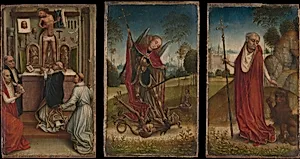
Saint Michael; The Mass of Saint Gregory; Saint Jerome
Medium
Oil on wood
Dimensions
Central panel 6 1/8 x 3 3/4 in. (15.6 x 9.5 cm); left panel 6 1/4 x 3 7/8 in. (15.9 x 9.8 cm); right panel 6 1/4 x 3 3/4 in. (15.9 x 9.5 cm)
Classification
Paintings
Department
European Paintings
Museum
Metropolitan Museum of Art, New York, NY
Credit
Bequest of William H. Herriman, 1920
Accession Number
21.134.3a–c
Rights
Public Domain
Tags
Art Historical Context
This exquisite triptych, titledSaint Michael; The Mass Saint Gregory; Saint Jerome is a delicate oil-on-wood painting attributed to the Master of the Saint Catherine Legend, an anonymous artist from the late medieval Northern European tradition. Comprising three tiny panels—each just over six inches tall and under four inches wide—it likely served as a portable devotional object for personal prayer. The central panel depicts *The Mass of Saint Gregory a popular vision of Pope Gregory the Great witnessing Christ's apparition during Mass, symbolizing the miracle of transubstantiation. Flanking it are Saint Michael, the archangel battling demons, and Saint Jerome, the scholar-saint often shown with his lion companion. Crafted in oil on wood, a technique prized for its luminous detail and jewel-like quality, the work exemplifies the meticulous style of Early Netherlandish painters. The Master's anonymous oeuvre, linked to Brussels workshops, often featured hagiographic scenes rich in symbolism, blending spiritual narrative with vivid iconography—demons under Michael's foot, Jerome's loyal lion, and divine figures evoking faith's mysteries. Housed in the Metropolitan Museum of Art's European Paintings department through the 1920 bequest of William H. Herriman, this intimate artwork invites visitors to ponder the saints' roles as protectors, scholars, and witnesses to the divine, bridging medieval piety with Renaissance precision in a remarkably compact form.