
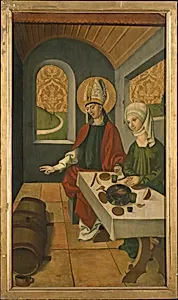
Saint Remigius Replenishing the Barrel of Wine; (interior) Saint Remigius and the Burning Wheat
ca. 1500–1505
Medium
Oil, gold, and white metal on wood
Dimensions
54 1/4 x 30 1/2 in. (137.8 x 77.5 cm)
Classification
Paintings
Department
European Paintings
Museum
Metropolitan Museum of Art, New York, NY
Credit
Purchase, 1871
Accession Number
71.33ab
Rights
Public Domain
Tags
Art Historical Context
This double-sided panel painting, created by an anonymous Swiss artist around 1500–1505, vividly captures the miracles of Saint Remigius, the 5th-century bishop of Reims revered as the "Apostle of the Franks." On the exterior, Saint Remigius performs the miracle of replenishing a depleted wine barrel during a famine, blessing it to overflow with wine—a symbol of divine providence and abundance. The interior depicts him miraculously transforming a burning wheat field into thriving crops, underscoring themes of salvation and renewal. Rendered in oil, gold, and white metal on wood, the work's opulent materials evoke the luminous quality of medieval manuscripts, with gold leaf providing a heavenly glow and metallic highlights adding sparkle to figures and vessels. Hailing from the late Gothic or early Renaissance period in Switzerland, this large-scale panel (over 4 feet tall) likely served as part of an altarpiece or devotional object in a church or private chapel. Saint Remigius's legends, tied to his role in baptizing Clovis I and converting the Franks to Christianity, were immensely popular in Northern Europe, inspiring feasts, pilgrimages, and art that celebrated everyday miracles amid agrarian hardships. The inclusion of men, women, and girls in lively scenes humanizes the divine intervention, reflecting late medieval piety. Acquired by the Metropolitan Museum of Art in 1871, this rare Swiss example showcases masterful narrative composition and intricate detailing, bridging Gothic storytelling with emerging Renaissance naturalism. Visitors will appreciate its tactile richness and enduring message of hope through faith.