
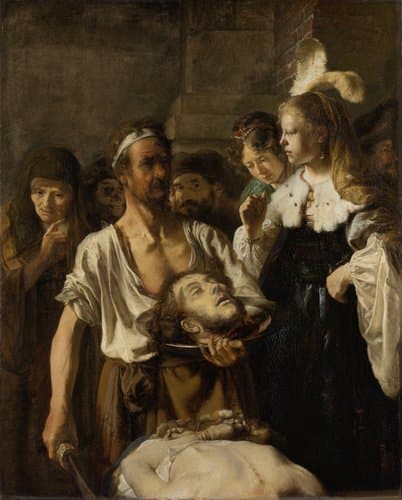
Salome ontvangt het hoofd van Johannes de Doper
c. 1640 - c. 1645
Medium
oil on canvas
Dimensions
149; 121
Rights
Public Domain
Art Historical Context
Rembrandt van Rijn's *Salome ontvangt het hoofd van Johannes de Doper* (Salome Receives the Head of John the Baptist), painted around 1640-1645, captures a dramatic biblical moment from the New Testament. Salome, daughter of Herodias, receives the severed head of John the Baptist on a platter from the executioner, surrounded by attendants in a tense, intimate scene. This oil on canvas masterpiece, measuring 149 x 121 cm, exemplifies Rembrandt's Baroque mastery during his mature Amsterdam period, blending psychological depth with theatrical staging. Rembrandt's signature chiaroscuro—dramatic contrasts of light and shadow—draws the eye to the head on the platter, heightening the emotional intensity and moral gravity of the story. Early owners and auction catalogs praised its "striking light," "beautiful colorit," and "masterly painting," noting the lifelike characters and composition. Initially misattributed to Carel Fabritius, it was recognized as Rembrandt's work by the 18th century, reflecting his profound influence on Dutch Golden Age art. Acquired by the Rijksmuseum in 1801 after a series of illustrious sales, this painting showcases Rembrandt's innovative use of oil to achieve rich textures and glowing effects, inviting viewers to ponder themes of power, sin, and tragedy that have inspired artists for centuries.
About the Artist
Rembrandt van Rijn · 1606–1669
Rembrandt Harmenszoon van Rijn (1606–1669) stands as one of the greatest visual artists in the history of Western art and the most important Dutch painter of the 17th century. Born in Leiden to a prosperous miller's family, Rembrandt transformed painting through his revolutionary use of light and shadow, his psychological depth in portraiture, and his elevation of etching to a fine art. His approx...