
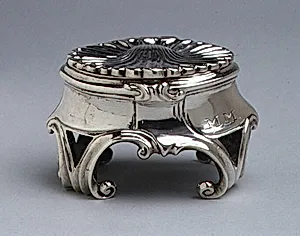
Salt
18th century
Medium
Silver
Dimensions
Overall: 1 7/8 × 2 in. (4.8 × 5.1 cm)
Classification
Metalwork-Silver
Culture
Spanish, Barcelona
Department
European Sculpture and Decorative Arts
Museum
Metropolitan Museum of Art, New York, NY
Credit
Gift of Mrs. Donald Gill, 1990
Accession Number
1990.141.2
Rights
Public Domain
Art Historical Context
Nestled in the Metropolitan Museum of Art's European Sculpture and Decorative Arts, *Salt* is a delicate 18th-century silver salt crafted by R. Eva Barcelona, Spain. Measuring just 1 7/8 × 2 inches, this petite metalwork piece exemplifies the exquisite tableware produced for affluent households during Spain's Enlightenment era. Gifted to the Museum by Mrs. Donald Gill in 199, it reflects Barcelona's vibrant silversmithing tradition, where skilled artisans like R. Eva created functional yet luxurious objects for dining rituals. Silver was a prized medium in 18th-century Europe, symbolizing wealth and status. Spanish silverwork from Barcelona often featured intricate chasing, engraving, or repoussé techniques, blending local craftsmanship with influences from French Rococo or Italian Baroque styles. As a salt cellar, *Salt* held a place of honor on the table—salt was a precious commodity, reserved for the elite, underscoring the object's role in everyday opulence and social display. This charming artifact invites us to imagine candlelit suppers in Catalan homes, where such finely wrought silver elevated the mundane to the magnificent. A testament to enduring artisanal skill, it highlights how decorative arts bridged utility and artistry in colonial Spain.