
Sample
Unknown Artist
19th century
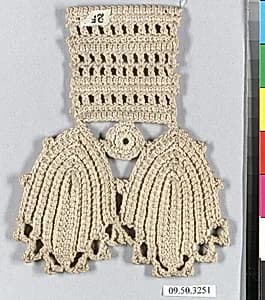
Medium
Crochet
Dimensions
L. 2 3/4 to 12 1/4 x W. 1 1/4 to 9 1/2 in. (7 to 31.1 x 3.2 to 24.1 cm)
Classification
Textiles-Laces
Culture
German
Department
European Sculpture and Decorative Arts
Museum
Metropolitan Museum of Art, New York, NY
Credit
Rogers Fund, 1909
Accession Number
09.50.3251
Rights
Public Domain
Art Historical Context
This delicate crochet lace sample from 19th-century Germany offers a glimpse into the intricate world of European decorative arts. Housed in the Metropolitan Museum of Art's Department of European Sculpture and Decor Arts (acquired through the Rogers Fund in 9), it exemplifies textiles classified as laces. Ranging from 2¾ to 12¼ inches in length and 1¼ to 9½ inches in width, these modest pieces showcase the precision of handmade needlework, likely intended as swatches for larger garments, trims, or household linens. Crochet, the medium here, emerged as a versatile and accessible technique in the 19th century, allowing skilled artisans—often women in domestic settings—to mimic the fine openwork of traditional bobbin laces without specialized looms. In German culture, such laces reflected a blend of folk craft and bourgeois elegance, popular during the Victorian era's fascination with ornamentation. This unknown artist's work highlights crochet's democratic appeal: affordable thread and a single hook produced airy, floral motifs rivaling pricier imports. As a cultural artifact, this sample underscores lace's role in everyday luxury, adorning collars, cuffs, and curtains. Its preservation celebrates the unsung mastery of anonymous makers, inviting us to appreciate the tactile artistry behind fashion's subtle splendor.